03 January 2007

Velingrad

Sofia night with Mr. VitoshaFirst, here are some time exposures (all 25 seconds) from New Year’s Eve. The first one—made at 22:00—is a calm view toward Mt. Vitosha (which was only barely visible by the naked eye.) After midnight, fireworks broke out all over the city; people were shooting them rooftops, balconies, and the street—it was like the fourth of July! ;-)Fireworks! In the third picture, you can see the burst of light coming from the official New Years/EU Accession party downtown—which we just watched on TV.

Spa

For the New Year’s holiday (of January 1st and 2nd) we went to spa resort town of Velingrad. 4th of July! We originally made reservations at an old restored hotel (check out the iron work over the door in the picture below!) but we decided on a nicer, newer, and cheaper hotel after tearing all over the city looking for the best value. As in many places in Bulgaria, these spas are fed by naturally hot, slightly minerally water.

Hammer & Sickle
poolThe pool was a balmy 31C (88F.) We also hit the Roman (steam) bath, sauna, and had massages. Mirena asked where people go relax in the US; I honestly couldn’t think of an equivalent. I am sure we do have spa resorts somewhere, but I think most people “just go the beach.”

TP

On the way back to Sofia, we came through Belovo, home of Belana Paper Mill—Bulgaria's largest producer of TP and paper towels. Along the road opposite the factory, the street was dotted with vendors selling all the various brands produced there. We stopped and Mirena bought a restaurant-sized roll of paper towels for 3 leva, but she said their prices were actually not that competitive; I suppose they lure Sofians into thinking they can get a good deal on their way home.roadside TP vendor

Below is one last time exposure I took at twilight as we were heading back to the expressway (notice the streaks of light from cars on the extreme right.)

Oh, and BTW, it is snowing right now! ;-)

30 December 2006

Happy New Year!

Mall of Sofia“Christmas” shopping

As a formerly communist country, New Years is still a bigger holiday in Bulgaria than Christmas day—nearly everyone is guaranteed a 4-day holiday: December 30, 31, January 1, and 2. Since presents are exchanged on this holiday, the shops and malls were packed Friday and Saturday, so I got to experience two last-minute Christmas shopping rushes this month!

Movies

Yesterday, I watched two movies. With the exception of a few French and Russian flicks, cinemas in Bulgaria show the same Hollywood blockbuster as nearly everywhere in the world, and—many times—premiering on the same weekend as in the US, since all they have to do is add subtitles. The cinemas in Sofia are all fairly new, with stadium seating like we have back home, but the ticket prices are significantly cheaper: 4 to 6 leva ($2.70-$4.04.)

First, I watch the new (re-make) James Bond film, Casino Royal. I found it to be a clumsy effort, and—as expected with any new actor playing Bond—I didn’t like Daniel Craig in this role; he seems too rough-edged for this role—Bond is supposed to be effortlessly suave. The parkour stunts were cool, but many of the traditional elements were missing, most notably the array of cool gadgets and the nude, female silhouettes in the opening title sequence. Like I’ve always said, the Bond franchise is just not the same since the end of the cold war, a sentiment seconded by Judy Dench’s “M” character in this film–which of course was poignant for me, watching this behind to old iron curtain.

Later that evening, Mirena and I went to see Robert Altman’s final film, A Prairie Home Companion. The star-studded cast (Meryl Streep, Lindsay Lohan, Kevin Kline, Woody Harrelson, and Tommy Lee Jones) brought in at least a half a dozen Bulgarians who were so bored/disappointed, they left before the end—even Mirena fell asleep. This is to be expected, since it was a sentimental film made for PHC fans (like me.) I wonder who thought it would be a good idea to subtitle and distribute it here.

27 December 2006

Back in BG

Christmas Eve at Micah & DebyWell, who’d have thought that I would be back in Bulgaria after only a month back home, but Mirena insisted and since I had nothing better to do—no job yet, and no new year’s eve plans—I had to come over for two weeks. Plus, Bulgaria will join the EU on January 1, so that should make for a big party!

I left for the airport on Christmas day, just as my mother was preparing her big dinner for the whole family; too bad I missed that, but we were all together on Christmas Eve for the magnificent banquet that Debora, my sister-in-law has made a tradition lately.

Brussels Christmas treeI had an 11-hour layover in Brussels, so despite being dead-tired from the overnight flight, I had to get out and explore the city. The weather was less than ideal (cold and cloudy,) but I was impressed—Brussels is a magnificent city. BTW, I have an overnight layover on the way back, so I’ll get to see more of it on January 9/10th.

That’s all for now…

13 December 2006

Back home

Sorry for not posting anything lately. I’m not quite sure what to write about anymore, and I’m afraid I’ve already lost most of my audience. Never the less, I do intend to keep blogging indefinitely regardless of where I am, so do come back every once in while.

So, for some highlights from the past 3 weeks: After arriving back home from being abroad for 16 months, my homecoming was overshadowed by an announcement from my brother and sister-in-law—they are going to have a baby! Obviously, we are all very happy for them (especially my parents.) But, hey, Joel just returned—you stole my thunder! ;-) Not to be outdone, my other brother and sister-in-law, made an announcement 2 weeks later…that’s right, they are going to have a baby too (in fact they are even farther alone!) So, yes, it is kinda hard being the only single person left in my family, but I’m used to it.

On the day before Thanksgiving, I met with some current IMBA students that I had met in Vienna back in March (they are doing the exact same program I did 2 years ago.) We met at the Carolina Coliseum to see our local, minor-league hockey team get beat by a team from Florida. This was first time I’ve ever been to a hockey game; thankfully Daniel (IMBA 2007) was able to explain the finer points of the game to me and his classmate, Antonio (who is from Puerto Rico, and had also never been to a hockey game.) What an incongruous sight, to see two teams from the Deep South playing a game that would, under natural circumstances, be impossible here.

Thanksgiving was great; I fully enjoyed the traditional feast and seeing family that I had not seen for over a year. Our last guest was my cousin from Germany, who is an au-pair here in South Carolina, unfortunately no one told her that Thanksgiving dinner takes place in the early afternoon; she arrived at 19:00—oh well, I know that feeling (lack of knowledge of local customs.)

The next day, I braved the crowds on the biggest shopping day of the year to browse the newest electronics at Best Buy and Circuit City. That evening I met two of my former classmates that still live in Columbia, one from Bulgaria and one from Romania. It was good to exchange notes on living/visiting each other’s countries.

The next week, I finally put my bike together and went out for a ride again. The weather was unseasonably warm—24C (75F.) Now I remembered what I liked about South Carolina! However, I have really gotten out of shape, because after my usual 53km (33 mi.) loop, I was exhausted. I promised myself to get back into shape, but the weather has turned colder, and I’ve only been out on one other occasion.

Hydro project

Ever since we moved down from Ohio and my father purchased the house where I grew up for most of my life, he has wanted to harness the water that flows out of the small lake that his property is situated on. However, through the years, this idea had been forgotten until my youngest brother expressed interest in it 2 years ago. powerhouseEver since then, they have been gung-ho about it, plowing right into the excavation and building of the power plant (pictured) without researching whether it is even economically and practically feasible. They have had no electrical, mechanical, or any other kind of engineering assistance or even any kind of drawings other than the proverbial “sketch on the back of an envelope.” Despite this lack of professionalism, it looks like they will soon have a turbine spinning in the power plant very soon. A week ago Saturday, we all piled into my brother’s pickup truck and drove to the outskirts of Atlanta to pick up the rebuilt turbine and associated hardware that they had ordered from an equally “seat of the pants” micro-hydro expert. This was loaded into the pickup and a trailer (pictured), and with a minimum of verbal instruction on how to put it all together, we headed back home. My other brother and I—who have been warning them against this foolhardy scheme—are impressed that they have gotten this far, but we’re still doubtful that they will ever produce any substantial revenue from selling power back to the local electrical co-op. We see it as a source of amusement, watching them from the sidelines as they muddle through. Despite our collective electrical and mechanical expertise, we have vowed not to help them in this foolish endeavor. Never the less, we do hope they are successful, and now that looks increasingly likely.

Reverse culture shock

For the last 3 calendar years, I have spent a total of 26 months abroad. After each homecoming, I wait for the phenomena called “reverse culture shock.” However, even after not touching American soil for 16 months (except for the US embassy), I still have not experienced it. In fact I am amazed at how natural it feels to be back home; it’s almost as if I haven’t been gone. Granted I am restless, and I am looking forward to the next adventure.

The one characteristic that is unmistakably evident is that everything in America is big! Food and beverage portions are big, hence Americans are big, and therefore they drive big SUV’s (it seems no one drives a regular car anymore.) I am alarmed at how much weight I’ve gained in the past 3 weeks; I now consciously watch out for overly processed, high fat food (that, granted, tastes so good!)

Seriously, what I have found downright sickening—especially around the holidays— is this run-away consumer culture. Why do we feel compelled to listen to marketers and buy junk for ourselves and our family and friends that we don't need? Then we rent storage space, buy/build sheds, and finally, get a bigger home just to store all this junk. Granted, Americans aren't alone in this compulsion; but since Americans and (mostly young) Europeans are used to financing their lifestyle with credit cards, it is more evident here. I expect this disease to spread to other parts of the world with the expansion of consumer credit. I am thankful that my parents drilled it into us that “if you don't have the money, you don't need it!”

30 November 2006

Current Events

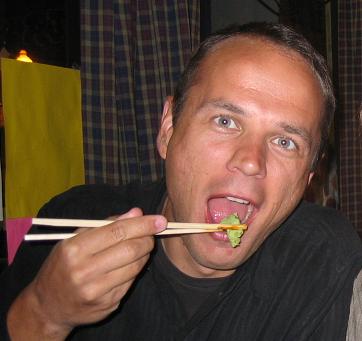
Joel eating wasabiMmm, Polonium wasabi. Muy caliente! (много лютив)

Seriously, I wonder: does radioactive hot taste caliente, picante, or neither. Related story

21 November 2006

Back in the US of A

After staggered farewells, and a hectic last two days in Bulgaria, I boarded a plane on Monday morning in Sofia and arrive in Columbia, SC the same evening—a total of 24 hours in transit thanks to a 5-hour layover in Dallas-Fort Worth. In the short term, I am looking forward to Thanksgiving dinner on Thursday, and in the long term, excited and a little anxious about the next phase of my life—the next adventure, wherever that may take me!

16 November 2006

TPS report

As MBAEC volunteers, we were required to write quarterly reports about our assignments including evaluations of our organizations, quarterly goals, “personal developments,” etc. The final report was expanded to include some final thought, so—since I have spent considerable time on these reports, and only 2 people for sure have ever read them—I will now publish the following experts.

Knowledge gained

Professionally, the most obvious thing I have learned is how international development is done. I had only a vague, academic perspective of this sector before I came to orientation and training in July [2005.] While I still do not understand a lot, I have certainly gained a lot of knowledge in this area over the past 15 months. From little things, like the acronyms that are ubiquitous in this field, to how the grant writing process works (including practical experience in evaluating grant proposals.) I have learned how projects are proposed, designed, and implemented through a hierarchy starting at USAID, through various contractors (individuals, NGOs, and for-profit enterprises,) all the way down to the mix of volunteers, locals, an others who actually implement these programs. Much of this has not been learned by direct experience, but because I am now in contact with people who are involved in this sector such as my own MBAEC colleagues, Peace Corps volunteers, and contractors on other projects.

Living in Bulgaria for over a year, means I have also learned a lot about the Bulgarian language, culture, cuisine, history, etc. Not only Bulgaria, but now I also have a much greater understanding of the Balkans and Eastern Europe; I have read books and Internet articles about this part of the world, visited museums, and talked with locals. One of the most important lessons learned is that ethnicity, rather than citizenship, is more important to national identity here, and therefore political borders are a matter of so much contention. Every country in this region has had an empire that extended well past its current borders at some point in history. To a greater or lesser extent, the people of the nations represented by these countries (I say this rather than “citizen” or “inhabitants,” since they all have sizable ethnic minorities) would like to see these “lost territories” back under their control—obviously impossible as most land is under the claim of multiple nations. Previously I had thought that European integration would solve this thorny issue, but now I understand why that will not be as easy as I had thought due to this deeply ingrained nationalism.

Personal Impact

Being born to immigrant parents and having traveled internationally on numerous occasions since childhood, (including a total of 10 months during business school) I thought I had a very international perspective (at least compared to other Americans.) However, this experience—living alone a foreign country for 16 months, traveling to other countries from there, and making friends and acquaintances from all kinds of backgrounds—has certainly made me more cosmopolitan; I am now more aware of the greater international issues and of diverse viewpoints.

Above all, I have become aware of just how lucky I am to be born in a highly developed (economically) country. I will be eternally grateful for the opportunities granted me by this happenstance. Even among my colleagues in the 2005 Corps, I have recognized how fortunate I am to possess an American passport; I was able to travel easily to wherever I wanted—which was not the case with my Indian friends, for example. Also, I am grateful that my native language is the language of interchange when two parties don’t know each other’s language; I have witnessed individuals trying to converse in bad English both professionally and in my travels. However, this blessing is also a curse in that there is little incentive for native English speakers like me to learn another language,and—in fact—makes it difficult to find others with the patience listen to our mangled attempt to speak their language when their English is almost always much better.

This being said, I am not more proud of America or being American; in fact, I have become less nationalistic as I have made friends with people from all over the world and sometimes lamented with them about the policies and regulations of our governments that artificially divide us; when on a personal level, we have a much closer kinship.

In regards to international development, in some ways I am more sympathetic to our efforts (and those of other countries and organizations,) but I have also become more cynical when I see how resources are often wasted and the outcome of so many projects seem to be ineffectual. Partially due to these insights, I have decided that economic development, as a career, is not for me.

Environmental Factors

In a final, and broader assessment of the business, economic, and cultural environment of Bulgaria, I would say the greatest challenge is the low expectations of Bulgarians for themselves and others. For example, most Bulgarians own their apartments or houses (many young people have inherited the residence of a deceased grandparent); this is great, but since most don’t have a car payment either, and services & food are extremely inexpensive, much of their modest salary can be applied to discretionary spending. This means they are happy with salaries that are nearly one tenth of what similarly educated and experienced workers in the US and western Europe make. Similarly, there is a low expectation of government and civic leaders, so corruption continues to be a problem. I don’t what the solution is, as it requires a conscious change by a majority (or at least, as significant portion) of the population; I just find it frustrating to try to help a bright and capable people who are just held back by their collective fatalism.