I am not going to tell you about last weekends trip to Bansko and Melnik although it was rather pleasant and interesting. Lately, this blog is sounding too much like a “what I did on summer vacation” report. Travel has to be experienced directly; there is no way that words, pictures, or even video can convey the serene yet surreal feeling of standing on a hill top near the Rozhen Monastery on a cold evening and looking out over the sandstone pyramids1 and—in the distance—the snow-capped peaks of the Pirin range bathed in faint light just after sunset. You would just have to be there; so get out there and travel!
1 The “sand pyramids” are a natural formation that the Melnik area is famous for.
14 November 2006
07 November 2006
Potato Man
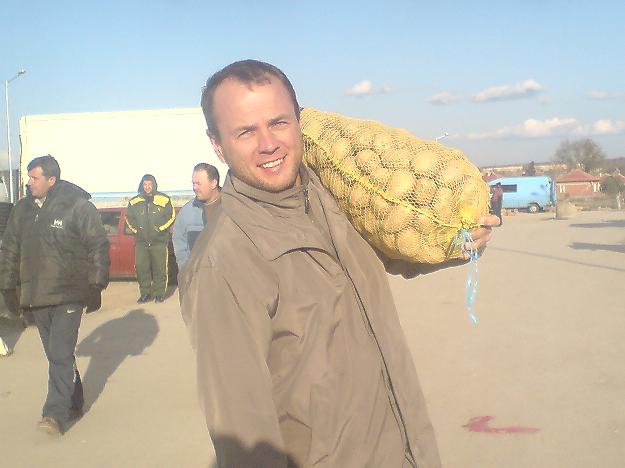 This weekend I rented a car again, and on Saturday, we made a day trip out to some small towns east of Plovdiv. We came across a vegetable bazaar, and upon learning that potatoes were only 38 stotinki a kilo, Mirena bought a 20 kg bag—which I am carrying back to the car in this pic.2
After returning to Sofia that evening, we went to the first of three of Barbara’s farewell dinners (the final farewell is tonight.) Barbara is Italian and works for an Italian child-welfare NGO; she was asked to move from the Bulgarian office to Ukraine—we will all miss her, especially Mirena.
The same evening, we went to the Marine Ball, because Ryan had two extra tickets from people that couldn’t come. I found it rather boring, but if I get a nice picture of us all dolled up, I will post it here for you. That’s what I’m reduced to now that I don’t have a working camera—begging others to email me their pictures.
And then there were two
On Friday, I arranged for all current and former MBAEC volunteers living in Sofia to have dinner together before Ryan and I leave this month. Most were able to attend (including Tom, who was a volunteer here in 1993, and never left.) As Americans, we are always craving spicy food here, so we met at Taj Mahal—an Indian restaurant. Sunday afternoon, our smaller group of 2005 and 2006 Corps met at the Radisson for Sunday brunch as a send off for Ryan, who is leaving today.
Life of Joel
Many of you have been wondering what my life is like now that my assignment is over. Well, many times it involves sleeping til a noonish hour, getting up and having a cup of tea or coffee3, checking my email & surfing the WWW, and then thinking about lunch. I usually bum off for the rest of the afternoon—usually reading—until Mirena gets off work. We eat out just about every day, sometimes with friends or at some kind of party or other gathering, and that’s a day!
Notes
1 Homer Simpson uses the expression “potato man” to gain entrance to the U2 concert in episode 5F09.
2 Photo credit: Mirena.
3 After years of experimenting with the gateway drugs of cola (34mg of caffeine) and tea (60mg), and resisting the entireties of family and friends to try the hard stuff—coffee (100+ mg)—I have started to drink Nescafé “3 in 1.” This is an easy to prepare, single serving package of a precision mixture of instant coffee, powdered milk, and sugar that I now use to get my caffeine kick and/or treat headaches, since I don’t have any ibuprofen anymore.
02 November 2006
Ridin
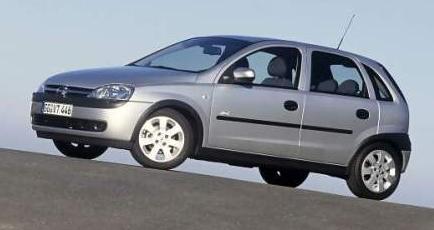 So, after not having driven a car for over a year (with the exception of a short trip in Germany last December) I finally rented a car on Saturday—a Opel Corsa like the one pictured, except it was kinda greenish with no wheel covers, and the antenna was snapped off; but what can you expect for 20 Euro a day.
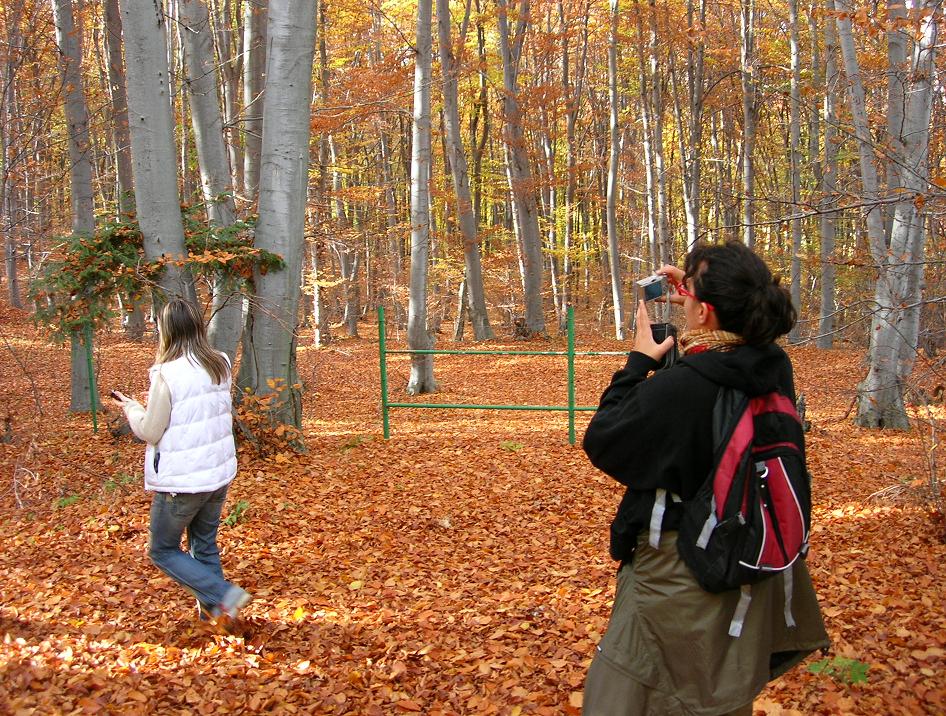 On Sunday, Mirena and I were in Dolna Banya—a small town about an hour away where a Peace Corps volunteer lives and had organized that weekend’s Hash. We rewarded for the effort by perfect weather, brilliant fall colors, and—afterwards—a delicious, 5-course Bulgarian meal of salad, chicken nettle soup, rice-stuffed peppers, tender pork fillets with mashed potatoes, and—for desert—pumkin banitsa. All very tasty and surprisingly inexpensive. At first, I thought this was a picture from Mirena’s new camera phone, but since you can see her clutching it, it obviously isn’t; and it can’t be Barbara’s either—as you can she is framing up a picture on her camera. Photo credit: Niltay (I think.) I love recursion!
On Monday morning, I drove Mirena to work—to this old, Dickensonian steel mill that has probably never seen better days under state control, and now looks even worse since being bought by an Indian concern that is obviously squeezing the last bit of profit out of it before it will undoubtedly have to be shut down for not even coming close to meeting any European environmental standards. Then I drove up to Svoge to visit another Peace Corps volunteer—Jennifer. We continued up (north, but actually downhill along the Iskar River)—an area with particularly interesting geography. Our goal was the “Seven Thrones Monastery,” which was disappointing—it was just a chapel with 7 rooms—but the scenery along the way made it worthwhile.
The rest of time before turning in the car on Tuesday afternoon, I used it to make preparations for my party that evening. It’s interesting how natural it felt to be back behind the wheel, cruising out to the mall and to big-box retailer at the edge of town (I went to Praktiker—the German answer to Lowes/Home Depot to buy a new fluorescent light for my bathroom.) However, I was glad to return it—traffic around Sofia is terrible most of the day, and—although I became a shameless sidewalk parker—it’s nearly impossible to find parking space anywhere downtown.
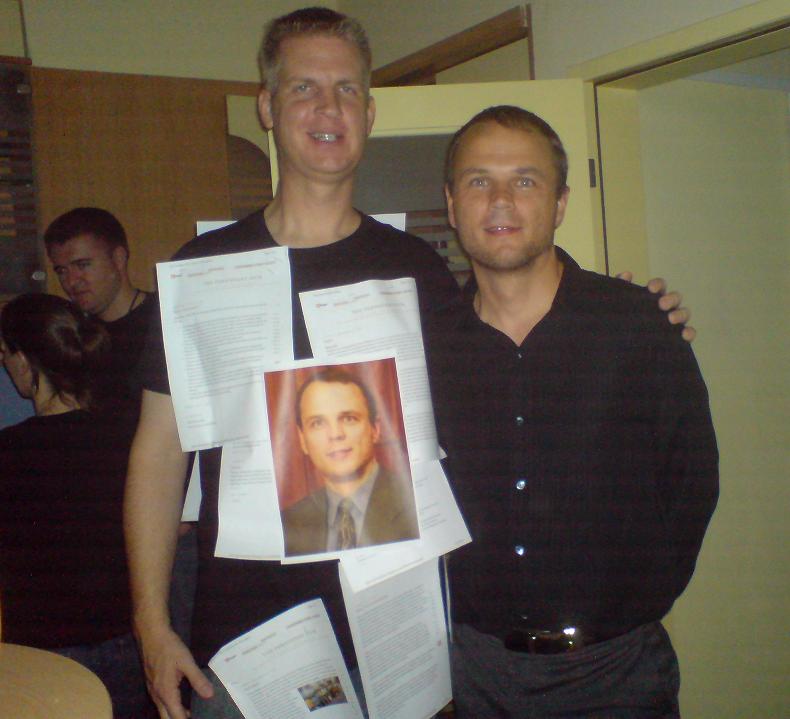 The party itself was fairly low-key, which is to be expected for a “school night.” Mike definitely walked away with the best costume prize—he came as a blog; specifically as The Persistent Itch! He stapled favorite posts from this blog to the front of his t-shirt and pages from Ryan’s blog, Blog-aria, to his back. He said that he thought of splattering the paper with fake blood, thus being a “blog stalker,” but decided that would be in poor taste. Photo credit: Mirena
Incidentally, as I write this on Thursday evening, it has begun to snow!
Also, you may notice the list of “friends’ blogs” to the right has become significantly shorter; I've eliminated anyone who hasn't written anything in the latest 2 months—which is being generous; no use sending you there if they haven't written anything new. Hopefully this may goad some them into writing again. ;-)
27 October 2006
Budapest revisited
On September 4th, I booked tickets to Budapest1 on Wizz airlines because the ticket was so cheap—just taxes and fees (37 Euro.) I picked the dates of October 13-16 randomly; in retrospect, I should have gone the next weekend (20-23) as this was the 50th anniversary of the 1956 uprising. I would have been able to experience all the associated events, demonstrations, and rioting that you have probably seen on TV.
This time I was on my own—no traveling companions—which was nice; I could do and see what I wanted and at my own pace—lots of walking. The weather cooperated beautifully; it was sunny and unseasonably warm all weekend—much more pleasant than December’s visist.2
Day 1 – Friday, October 13th
Thankfully, Wizz had changed their Sofia flight schedules from crack-of-dawn and late night flights to the late afternoon meaning I could leisurely mosey over to the airport—that is, if I had noticed the time and had everything packed up. The flight was uneventful, and due to the time zone difference, I arrived in Budapest at the same time I left Sofia. This time I found the bus that goes between the airport and the metro station, thus avoiding the 4400 Forint ($22) minibus service. Alighting from the metro at Deak Ter. (the central metro station) I made my way up to the street, but didn’t recognize any landmarks (I had no map, no reservations, and only a vague recollection of where the hostel was that we had stayed at last time.) However, after walking just one block, I got my bearings and found the hostel with no problem.
Day 2 – Saturday, October 14th
The goal for this day was to visit the Szechenyi Thermal Baths, which I did. I soaked in hot water of various temperatures for nearly 3 hours. In fact, I think I may have overdone it a little. Ignoring the “recommended time” signs—those are for wimps—I stayed in a steam bath and then sauna for over 20 minutes and then plunged into the icy cool-down pool. I got somewhat woozy, and my heart began racing—and continued to race for the rest of the day; guess I should have taken it easier.
After my soak, I saw Hero’s Square, and a new monument that would be unveiled the next week in commemoration of the 50th anniversary of the short-lived uprising against the Soviets in 1956. At some point in the day, I also saw Hungary’s magnificent parliament building, and a remnant of the previous month’s demonstration: a tent city of protesters right in front of the parliament.
Day 3 – Sunday, October 15th
I had noticed in a tourist magazine that the Budapest Hash House Harriers was having a run this morning, so I showed up at the appointed place, and met another group of friendly expats. This particular morning, the Budapest Marathon was also taking place, so we watched some of the top runners pass us along the Danube River at about the 28 km mark before heading out for our own exercise. They aren’t quite as organized as the Sofia Hash; the first couple of minutes were spent determining where we would hash and who would be the hare—something that is determined weeks in advance in Sofia. Anyhow, we had a nice run/walk on a steep hill at the western border of old Buda. Afterward we tried a Hungarian delicacy: Lángos, which is just like “elephant ears” you would find at the state fair, except instead of powered sugar, it is covered with sour cream, cheese, and garlic sauce—it’s actually quite good.
That evening, I finally met this blog’s number one reader, Emese,3 for drinks and some real Hungarian goulash.
Day 4 – Monday, October 16th
On my last morning, I had a breakfast of palachinki again, and then set out for Gellért Hill. This is a park situated on the steep slopes over the banks of the Danube on the Buda side. It is criss-crossed walking trails that visit several important sites, most visibly, the citadel and statue of “Liberty and Freedom” at the top. After that, it was time to head to the airport for my 15:00 flight back to Sofia.
Notes
1 Despite my expanded linguistic portfolio, I was not able to figure out much Hungarian, as it is a Finno-Ugric (non Indo-European) language. All I know for sure is that an “s” doesn’t make the “s” sound unless it is followed by a “z”; so Budapest is pronounced Budapesht, Emese is pronounced Emeshey, and bus is spelled “busz.”
2 Accounts of my previous trips to Budapest can be found here:3 Emese is this blog’s number one fan based on number of comments submitted, although Simon/Bubba is rising through the ranks.
This time I was on my own—no traveling companions—which was nice; I could do and see what I wanted and at my own pace—lots of walking. The weather cooperated beautifully; it was sunny and unseasonably warm all weekend—much more pleasant than December’s visist.2
Day 1 – Friday, October 13th
Thankfully, Wizz had changed their Sofia flight schedules from crack-of-dawn and late night flights to the late afternoon meaning I could leisurely mosey over to the airport—that is, if I had noticed the time and had everything packed up. The flight was uneventful, and due to the time zone difference, I arrived in Budapest at the same time I left Sofia. This time I found the bus that goes between the airport and the metro station, thus avoiding the 4400 Forint ($22) minibus service. Alighting from the metro at Deak Ter. (the central metro station) I made my way up to the street, but didn’t recognize any landmarks (I had no map, no reservations, and only a vague recollection of where the hostel was that we had stayed at last time.) However, after walking just one block, I got my bearings and found the hostel with no problem.
Day 2 – Saturday, October 14th
The goal for this day was to visit the Szechenyi Thermal Baths, which I did. I soaked in hot water of various temperatures for nearly 3 hours. In fact, I think I may have overdone it a little. Ignoring the “recommended time” signs—those are for wimps—I stayed in a steam bath and then sauna for over 20 minutes and then plunged into the icy cool-down pool. I got somewhat woozy, and my heart began racing—and continued to race for the rest of the day; guess I should have taken it easier.
After my soak, I saw Hero’s Square, and a new monument that would be unveiled the next week in commemoration of the 50th anniversary of the short-lived uprising against the Soviets in 1956. At some point in the day, I also saw Hungary’s magnificent parliament building, and a remnant of the previous month’s demonstration: a tent city of protesters right in front of the parliament.
Day 3 – Sunday, October 15th
I had noticed in a tourist magazine that the Budapest Hash House Harriers was having a run this morning, so I showed up at the appointed place, and met another group of friendly expats. This particular morning, the Budapest Marathon was also taking place, so we watched some of the top runners pass us along the Danube River at about the 28 km mark before heading out for our own exercise. They aren’t quite as organized as the Sofia Hash; the first couple of minutes were spent determining where we would hash and who would be the hare—something that is determined weeks in advance in Sofia. Anyhow, we had a nice run/walk on a steep hill at the western border of old Buda. Afterward we tried a Hungarian delicacy: Lángos, which is just like “elephant ears” you would find at the state fair, except instead of powered sugar, it is covered with sour cream, cheese, and garlic sauce—it’s actually quite good.
That evening, I finally met this blog’s number one reader, Emese,3 for drinks and some real Hungarian goulash.
Day 4 – Monday, October 16th
On my last morning, I had a breakfast of palachinki again, and then set out for Gellért Hill. This is a park situated on the steep slopes over the banks of the Danube on the Buda side. It is criss-crossed walking trails that visit several important sites, most visibly, the citadel and statue of “Liberty and Freedom” at the top. After that, it was time to head to the airport for my 15:00 flight back to Sofia.
Notes
1 Despite my expanded linguistic portfolio, I was not able to figure out much Hungarian, as it is a Finno-Ugric (non Indo-European) language. All I know for sure is that an “s” doesn’t make the “s” sound unless it is followed by a “z”; so Budapest is pronounced Budapesht, Emese is pronounced Emeshey, and bus is spelled “busz.”
2 Accounts of my previous trips to Budapest can be found here:3 Emese is this blog’s number one fan based on number of comments submitted, although Simon/Bubba is rising through the ranks.
03 October 2006
Not Constantinople
Since our assignments are all done, several of my MBAEC colleagues and I decided to meet and celebrate in Istanbul (not Constantinople.)1 Norm left Azerbaijan on Friday, as did Ryan and Mike (from Sofia—via a night train.) As I had a wedding to attend on Saturday, (an American coworker at Serdon) I took a bus on Sunday morning, and Paris—after some complications—met us on Monday, as he was there on business.
Day 1 – Sunday, October 1, 2006
The bus ride was a pleasant enough, but long—10 hours! I opted to travel during the day, so I could see the Bulgarian and Turkish countryside pass by my window (plus I don’t sleep well in a sitting position.) It was reasonably enjoyable; I got to see a lot of Bulgaria that I’d never seen before including a major city, Haskovo, which I had previously never even heard of.
After being spoiled with the privileged of being (with) a diplomat the previous week, the experience at the border was tiresome. Mind you, not the inspection itself, which was cursory, but waiting as the buses and the luggage of passengers on those buses in front of us was thoroughly inspected. Apparently the customs officials scrutinize the cheap bus lines more often used by smugglers (of whatever) than the comparatively ritzy 40 leva “Metro Plus” bus line I was using.2
The scenery changed considerably as soon as we entered Turkey. The arid hills were dotted with a different style of houses, and the skyline was punctuated with the minarets of mosques. However, more importantly—the road went from a pothole strewn 2-lane to a 6-lane expressway.
We rolled into the outskirts of Istanbul3 around dusk and were dropped off in a maze-like, multi-story bus station. I tried to find my way out—to public transportation—but eventually gave up and paid a taxi 20 Euros (the same amount as the bus ticket from Bulgaria) to take me to the hostel in Sultanahmet, where we were staying. I looked for Ryan, Mike, and Norm, but didn’t see them; so headed out for a bite to eat, since I was famished from the bus ride. As it was after sundown during Ramadan, (or Ramazan as they call it in Turkish) there was a festive atmosphere as people were eating their first meal since breakfast.
Eventually I found my friends, and we went out to eat again—which was an adventure in and of itself! The first restaurant we tried didn’t sell beer because it was next to a mosque—which was a deal breaker for Mike—but it also didn’t have everything on the menu because the post-sundown rush of Ramadan had already cleaned them out. We settled on another one where the waiter assured us they had everything on the menu including “lavash” flat bread. When our food arrived there was no lavash, and they had substituted noodles for rice. Mike pointed this out to the waiter and even showed him on the menu that we were supposed to get rice (because the waiter said rice was extra.) After multiple trips back and forth, he admitted that these items were “finished.” Then—and this has now become our catchphrase for the journey—he said: “Yes, my friend, you are correct, but I am correct as well.”—classic!
Day 2 – Monday, October 2, 2006
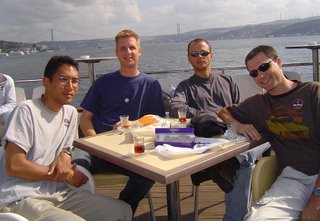 Monday morning we were up bright and early for our Bosporus cruise. A minibus picked us up in front of our hotel and took us to a consolidation point—on the side of a busy highway—where we waited around and eventually got on another private bus that would take us to the boat, but first a side trip to the spice market (which we could have found on our own.) The boat trip was pricier and a bit nicer than the one Ben and I took 2 years ago4, but it was basically the same thing: mainly showing the multi-million dollar houses on the Asian side. We noticed that nearly each hilltop (perhaps representing a neighborhood or wealthy individual) featured a soaring flagpole and an enormous Turkish flag—the size you would only see at an American car dealership.
The explanation was given in English, German, and Spanish; and each a little different because we’d be 5 minutes further along the shore when the language would change. I couldn’t be sure, but the woman who was doing the explanations in Spanish seemed to be talking about totally different things; too bad Bulgarian has pushed out the last remaining Spanish language skillz out of my head.
After the cruise, we got off our bus at Taksim Square in order to explore the modern part of Istanbul rather than being shuttled back to Sultanahmet. As we strolled down the famous pedestrian street, İstiklal Avenue, we stopped for a quick lunch at cheap but tasty Turkish cafeteria. At the end of İstiklal, we went down a street much like the “satellite TV street” that Ben and I walked up 2 years ago,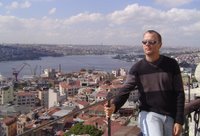 but—as Ryan noted—this was definitely “music street”; there were 100 times more stores selling musical instruments of all kinds plus sound reinforcement equipment than in all of Bulgaria—one would think there is a lot of live music in Istanbul, but we never found any. Halfway down the hill, we stopped to go up the Galata Tower for the panoramic view and the obligatory pictures.
That afternoon a Turkish girl, which Mike had met on a previous trip here, took us to a few leather goods stores because Mike wanted to buy a leather jacket. After visiting a few stores, trying on innumerable jackets, and—of course—haggling, the jacket was bought. As usual, I was bored, but started looking at jackets for myself, and found a really nice one I liked for 400 Lira, unfortunately I did not buy it—as you know, I am not an impulsive shopper. The stores were spacious, modern edifices, but soul-less; I imagine their predecessor was a chaotic, crowded marketplace like the Grand Bazaar or spice market—an unfortunate change.
Day 3 – Tuesday, October 3, 2006
Tuesday, the occupancy of our hostel room decreased by 75% as Mike—the only one of us with a job—had to head out early to catch a flight back to Sofia and get back behind his desk that morning. The rest of us had our breakfast of one hard-boiled egg, one slice of tomato and cucumber, one olive, a piece of white cheese, and some bread. Thus fortified, we set out for another day of touristing. Ryan and Norm went to check out the Topkapı Palace, and I—because I had seen the palace on my previous trip—went to see Hagia Sofia (the vast Byzantine-era church turned mosque, then—in the last century—into a museum.) For comparison, I also checked out the Blue Mosque (Sultan Ahmed Mosque) next door; it is smaller, but notable for being the only mosque in Turkey with 6 minarets. After wandering around the old town for a while, I met up with Norm and Ryan again and had lunch. Then we hit the spice market for souvenirs—especially Turkish delight (of which Norm eventually bought 10 kilos for his friends and coworkers in Azerbaijan—they are a big fan of anything from Turkey.)
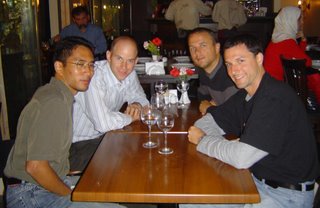 That evening we finally met up with Paris, who was staying near Taksim Square. For the second night in a row, we ate a seafood restaurant. Here I saw something I’ve never seen before: a large fish, encrusted in a thick layer of salt, baked in an oven. The waiter brings it to the table, chisels it out of the salt, de-bones it, and then servers everyone at the table (usually four.) It looks good; I’ll have to try that sometime.
Since Paris had a business meeting on the other side of town the next morning, and Ryan & I had to catch the bus back to Sofia at 9:00, we made a short night of it. It was great that we were able to reunite at the end of our assignment; we were five of the eleven 2005 Corps—a pretty good turn out, considering that three had finished early and were already back home.
Notes
1 Berlin, Irving; Kennedy, Jimmy. “Istanbul (Not Constantinople).” 1929. (most recently covered by They Might Be Giants.)
2 From what I experienced, the main benefit of using “Metro Plus” is its modern buses with toilets—which, however are used as storage space—and an iridescent-silver and blue haired “stewardess” who served us tea and snacks.
3 Spelled İstanbul in Turkish—yeah, even a capital “i” has to have a dot over it.
4 See http://joel.froese.com/sb04.htm for the account of my previous trip to Istanbul.
All photographs in this post are courtesy of Norm.
Day 1 – Sunday, October 1, 2006
The bus ride was a pleasant enough, but long—10 hours! I opted to travel during the day, so I could see the Bulgarian and Turkish countryside pass by my window (plus I don’t sleep well in a sitting position.) It was reasonably enjoyable; I got to see a lot of Bulgaria that I’d never seen before including a major city, Haskovo, which I had previously never even heard of.
After being spoiled with the privileged of being (with) a diplomat the previous week, the experience at the border was tiresome. Mind you, not the inspection itself, which was cursory, but waiting as the buses and the luggage of passengers on those buses in front of us was thoroughly inspected. Apparently the customs officials scrutinize the cheap bus lines more often used by smugglers (of whatever) than the comparatively ritzy 40 leva “Metro Plus” bus line I was using.2
The scenery changed considerably as soon as we entered Turkey. The arid hills were dotted with a different style of houses, and the skyline was punctuated with the minarets of mosques. However, more importantly—the road went from a pothole strewn 2-lane to a 6-lane expressway.
We rolled into the outskirts of Istanbul3 around dusk and were dropped off in a maze-like, multi-story bus station. I tried to find my way out—to public transportation—but eventually gave up and paid a taxi 20 Euros (the same amount as the bus ticket from Bulgaria) to take me to the hostel in Sultanahmet, where we were staying. I looked for Ryan, Mike, and Norm, but didn’t see them; so headed out for a bite to eat, since I was famished from the bus ride. As it was after sundown during Ramadan, (or Ramazan as they call it in Turkish) there was a festive atmosphere as people were eating their first meal since breakfast.
Eventually I found my friends, and we went out to eat again—which was an adventure in and of itself! The first restaurant we tried didn’t sell beer because it was next to a mosque—which was a deal breaker for Mike—but it also didn’t have everything on the menu because the post-sundown rush of Ramadan had already cleaned them out. We settled on another one where the waiter assured us they had everything on the menu including “lavash” flat bread. When our food arrived there was no lavash, and they had substituted noodles for rice. Mike pointed this out to the waiter and even showed him on the menu that we were supposed to get rice (because the waiter said rice was extra.) After multiple trips back and forth, he admitted that these items were “finished.” Then—and this has now become our catchphrase for the journey—he said: “Yes, my friend, you are correct, but I am correct as well.”—classic!
Day 2 – Monday, October 2, 2006
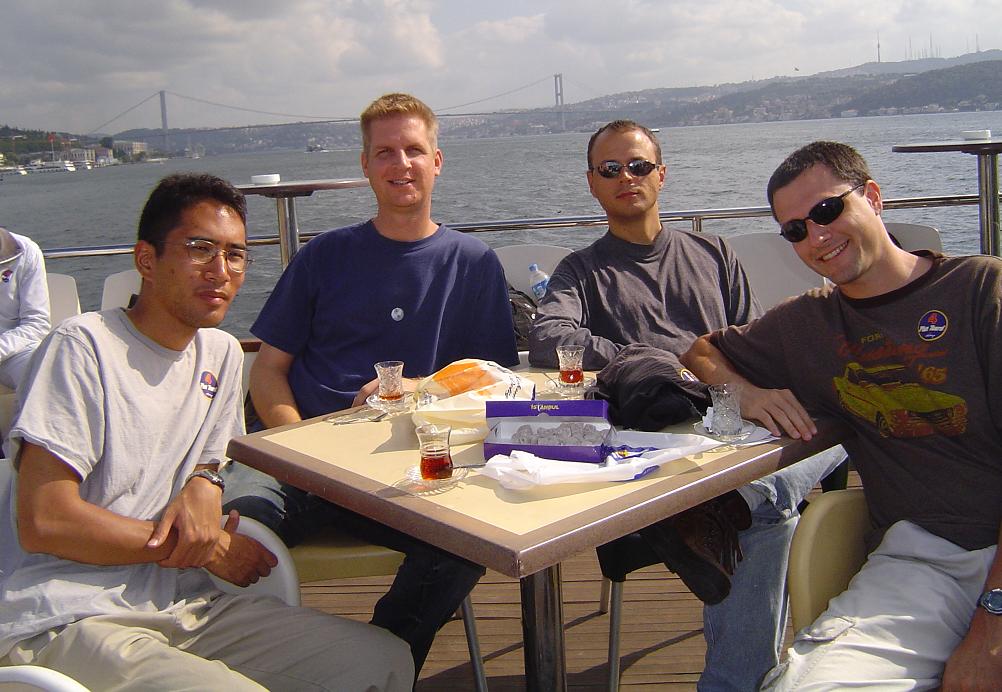 Monday morning we were up bright and early for our Bosporus cruise. A minibus picked us up in front of our hotel and took us to a consolidation point—on the side of a busy highway—where we waited around and eventually got on another private bus that would take us to the boat, but first a side trip to the spice market (which we could have found on our own.) The boat trip was pricier and a bit nicer than the one Ben and I took 2 years ago4, but it was basically the same thing: mainly showing the multi-million dollar houses on the Asian side. We noticed that nearly each hilltop (perhaps representing a neighborhood or wealthy individual) featured a soaring flagpole and an enormous Turkish flag—the size you would only see at an American car dealership.
The explanation was given in English, German, and Spanish; and each a little different because we’d be 5 minutes further along the shore when the language would change. I couldn’t be sure, but the woman who was doing the explanations in Spanish seemed to be talking about totally different things; too bad Bulgarian has pushed out the last remaining Spanish language skillz out of my head.
After the cruise, we got off our bus at Taksim Square in order to explore the modern part of Istanbul rather than being shuttled back to Sultanahmet. As we strolled down the famous pedestrian street, İstiklal Avenue, we stopped for a quick lunch at cheap but tasty Turkish cafeteria. At the end of İstiklal, we went down a street much like the “satellite TV street” that Ben and I walked up 2 years ago,
 but—as Ryan noted—this was definitely “music street”; there were 100 times more stores selling musical instruments of all kinds plus sound reinforcement equipment than in all of Bulgaria—one would think there is a lot of live music in Istanbul, but we never found any. Halfway down the hill, we stopped to go up the Galata Tower for the panoramic view and the obligatory pictures.
That afternoon a Turkish girl, which Mike had met on a previous trip here, took us to a few leather goods stores because Mike wanted to buy a leather jacket. After visiting a few stores, trying on innumerable jackets, and—of course—haggling, the jacket was bought. As usual, I was bored, but started looking at jackets for myself, and found a really nice one I liked for 400 Lira, unfortunately I did not buy it—as you know, I am not an impulsive shopper. The stores were spacious, modern edifices, but soul-less; I imagine their predecessor was a chaotic, crowded marketplace like the Grand Bazaar or spice market—an unfortunate change.
Day 3 – Tuesday, October 3, 2006
Tuesday, the occupancy of our hostel room decreased by 75% as Mike—the only one of us with a job—had to head out early to catch a flight back to Sofia and get back behind his desk that morning. The rest of us had our breakfast of one hard-boiled egg, one slice of tomato and cucumber, one olive, a piece of white cheese, and some bread. Thus fortified, we set out for another day of touristing. Ryan and Norm went to check out the Topkapı Palace, and I—because I had seen the palace on my previous trip—went to see Hagia Sofia (the vast Byzantine-era church turned mosque, then—in the last century—into a museum.) For comparison, I also checked out the Blue Mosque (Sultan Ahmed Mosque) next door; it is smaller, but notable for being the only mosque in Turkey with 6 minarets. After wandering around the old town for a while, I met up with Norm and Ryan again and had lunch. Then we hit the spice market for souvenirs—especially Turkish delight (of which Norm eventually bought 10 kilos for his friends and coworkers in Azerbaijan—they are a big fan of anything from Turkey.)
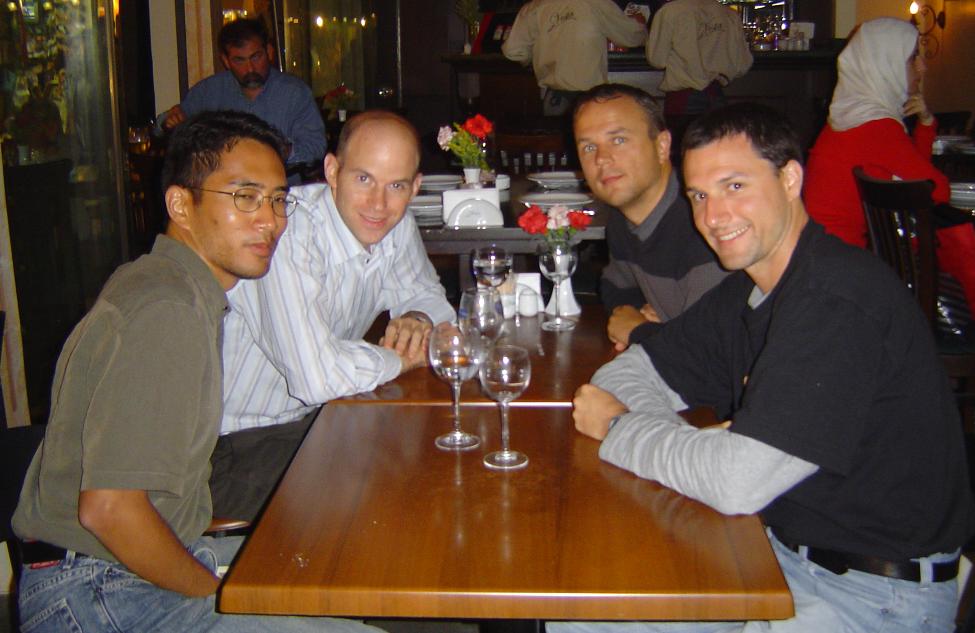 That evening we finally met up with Paris, who was staying near Taksim Square. For the second night in a row, we ate a seafood restaurant. Here I saw something I’ve never seen before: a large fish, encrusted in a thick layer of salt, baked in an oven. The waiter brings it to the table, chisels it out of the salt, de-bones it, and then servers everyone at the table (usually four.) It looks good; I’ll have to try that sometime.
Since Paris had a business meeting on the other side of town the next morning, and Ryan & I had to catch the bus back to Sofia at 9:00, we made a short night of it. It was great that we were able to reunite at the end of our assignment; we were five of the eleven 2005 Corps—a pretty good turn out, considering that three had finished early and were already back home.
Notes
1 Berlin, Irving; Kennedy, Jimmy. “Istanbul (Not Constantinople).” 1929. (most recently covered by They Might Be Giants.)
2 From what I experienced, the main benefit of using “Metro Plus” is its modern buses with toilets—which, however are used as storage space—and an iridescent-silver and blue haired “stewardess” who served us tea and snacks.
3 Spelled İstanbul in Turkish—yeah, even a capital “i” has to have a dot over it.
4 See http://joel.froese.com/sb04.htm for the account of my previous trip to Istanbul.
All photographs in this post are courtesy of Norm.
23 September 2006
Serbia
Road Trip
September 22 is Independence Day in Bulgaria, so we have a 3-day weekend. Ryan, Kat, Ian, and I decided what better way to celebrate this than a road trip to another country. So, Friday morning we all packed into her car and headed for the border. The road trip itself was rather uneventful as the highways in Serbia are generally nicer than in Bulgaria; at times, we could imagine we were driving on a rural interstate in middle America. On the way back we discussed whether it looked more like western Ohio (my choice), Iowa, or Kentucky—you get the idea. Furthermore, we were 4 Americans riding in an SUV listening to American music from our iPods; the only thing that hinted to our location was the occasional sign listing the towns and villages we were passing in Cyrillic and Latin.
Beograd
We only had a map of downtown Beograd (I can’t figure out why we call it Belgrade,) but amazingly had little problem finding our hotel in the old town. Arriving in the late afternoon, we again had a hard time finding lunch (as Ben & I did 2 years ago; click here and scroll down to day 7), but we eventually satiated our hunger and thirst. Over the next two days we explored area churches and museums centering around Knez Mihailova Street—a beautiful pedestrian area in the heart of the old town, again something sorely missing in Sofia. Saturday afternoon we took a one and a half hour boat tour up and down the Sava River, which was nice except for the industrial areas on the Sava; they should have shown us more of the Danube instead. Sunday, before we left, we head west to the town Zemun, which used to mark the eastern extent of the Austro-Hungarian Empire, and retains much of the architectural elements of this civilization. This is one of the nice benefits of having a car; we would not have made the effort by bus or taxi.
Serbo-Croatian
The Serbian, Croatian, and Bosnian languages are actually dialects of each other (but, since each hates each the other’s guts, they insist that they each have a unique language.) Like Bulgarian, Serbo-Croatian is a Slavic language, and aside from Macedonian (which, in reality is a dialect of Bulgarian) is most closely related to Bulgarian—much like German and Dutch, I suppose. As such, we were able to make out most signs and understand a good bit of what people said (OK, not me, but Kat—she studied Bulgarian for 5 months versus our 2 months.) However, none of us felt comfortable trying to speak it for fear of being doubly wrong; at least in Bulgaria people can tell we are trying to speak their language. Serbs could probably understand a Bulgarian, but not necessarily an American’s mangled Bulgarian. One interesting difference is that this language has a direct, official, and unambiguous mapping to a (modified) Latin alphabet (e.g. the “sh” sound made by the Cyrillic ш is represented in Latin as š.) Practically, this means the more universal Latin alphabet is increasingly used in Serbia (and already exclusively in Croatia.) Bulgaria, on the other hand, will never abandon the Cyrillic alphabet, as they take pride in the fact that Cyril and Methodius invented it here.
Diplomatic Immunity!1
At the border, there was a line of truck on both sides waiting to clear customs at least 2 or 3 miles long; we estimate that many of them would be there for at least 12 hours. Passenger vehicles, on the other hand, could carefully pass trucks along the winding 2-lane road leading to the border. We had even another advantage when we reached the border complex (exit control, disinfection, immigration, customs, and road tax booths); since Kat was a foreign service officer, and her vehicle had diplomatic tags, we were whisked in front of everyone into the corps diplomatique express line. I couldn’t help but chuckle “ha, suckers!” at the mere mortals who had to wait an additional half hour.
Contest
Since three of us are bloggers, there is now an unofficial contest going. I obviously win the “quickest to blog” award since I posted part of this from an Internet café on Saturday. Ryan and Ian are now vying for the most interesting and most humorous awards.
1Lethal Weapon 2. 1989. [IMDB]
September 22 is Independence Day in Bulgaria, so we have a 3-day weekend. Ryan, Kat, Ian, and I decided what better way to celebrate this than a road trip to another country. So, Friday morning we all packed into her car and headed for the border. The road trip itself was rather uneventful as the highways in Serbia are generally nicer than in Bulgaria; at times, we could imagine we were driving on a rural interstate in middle America. On the way back we discussed whether it looked more like western Ohio (my choice), Iowa, or Kentucky—you get the idea. Furthermore, we were 4 Americans riding in an SUV listening to American music from our iPods; the only thing that hinted to our location was the occasional sign listing the towns and villages we were passing in Cyrillic and Latin.
Beograd
We only had a map of downtown Beograd (I can’t figure out why we call it Belgrade,) but amazingly had little problem finding our hotel in the old town. Arriving in the late afternoon, we again had a hard time finding lunch (as Ben & I did 2 years ago; click here and scroll down to day 7), but we eventually satiated our hunger and thirst. Over the next two days we explored area churches and museums centering around Knez Mihailova Street—a beautiful pedestrian area in the heart of the old town, again something sorely missing in Sofia. Saturday afternoon we took a one and a half hour boat tour up and down the Sava River, which was nice except for the industrial areas on the Sava; they should have shown us more of the Danube instead. Sunday, before we left, we head west to the town Zemun, which used to mark the eastern extent of the Austro-Hungarian Empire, and retains much of the architectural elements of this civilization. This is one of the nice benefits of having a car; we would not have made the effort by bus or taxi.
Serbo-Croatian
The Serbian, Croatian, and Bosnian languages are actually dialects of each other (but, since each hates each the other’s guts, they insist that they each have a unique language.) Like Bulgarian, Serbo-Croatian is a Slavic language, and aside from Macedonian (which, in reality is a dialect of Bulgarian) is most closely related to Bulgarian—much like German and Dutch, I suppose. As such, we were able to make out most signs and understand a good bit of what people said (OK, not me, but Kat—she studied Bulgarian for 5 months versus our 2 months.) However, none of us felt comfortable trying to speak it for fear of being doubly wrong; at least in Bulgaria people can tell we are trying to speak their language. Serbs could probably understand a Bulgarian, but not necessarily an American’s mangled Bulgarian. One interesting difference is that this language has a direct, official, and unambiguous mapping to a (modified) Latin alphabet (e.g. the “sh” sound made by the Cyrillic ш is represented in Latin as š.) Practically, this means the more universal Latin alphabet is increasingly used in Serbia (and already exclusively in Croatia.) Bulgaria, on the other hand, will never abandon the Cyrillic alphabet, as they take pride in the fact that Cyril and Methodius invented it here.
Diplomatic Immunity!1
At the border, there was a line of truck on both sides waiting to clear customs at least 2 or 3 miles long; we estimate that many of them would be there for at least 12 hours. Passenger vehicles, on the other hand, could carefully pass trucks along the winding 2-lane road leading to the border. We had even another advantage when we reached the border complex (exit control, disinfection, immigration, customs, and road tax booths); since Kat was a foreign service officer, and her vehicle had diplomatic tags, we were whisked in front of everyone into the corps diplomatique express line. I couldn’t help but chuckle “ha, suckers!” at the mere mortals who had to wait an additional half hour.
Contest
Since three of us are bloggers, there is now an unofficial contest going. I obviously win the “quickest to blog” award since I posted part of this from an Internet café on Saturday. Ryan and Ian are now vying for the most interesting and most humorous awards.
1Lethal Weapon 2. 1989. [IMDB]
11 September 2006
Scavengers
Friday afternoon was a moving day of sorts at Serdon. Namely, we were moving stuff that had been accumulating over the years from the attic storage room to the new apartment (which will be renovated into new offices) and—more often—to the dumpsters on the street. It was a dusty, dirty, and strenuous affair; the attic is five floors up and there is no elevator in this building. After the first trip down to the street, I wondered how long it would take before gypsies…er,  Roma would show up to scavenge recyclable metal from the junk we were brining down. Well, I quickly found out, because on the second trip, they were already there picking through the old furniture and office equipment, prying and hacking off any piece of metal for which they could get a few stotinki. Later that afternoon, I took this picture; note, the only thing left is wood and plastic—impressive.
Farewell Julia
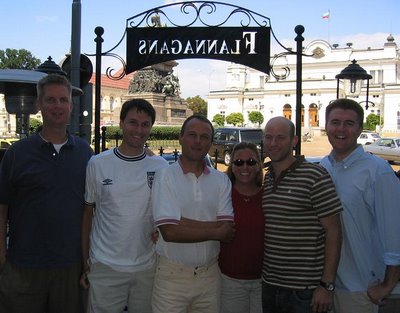
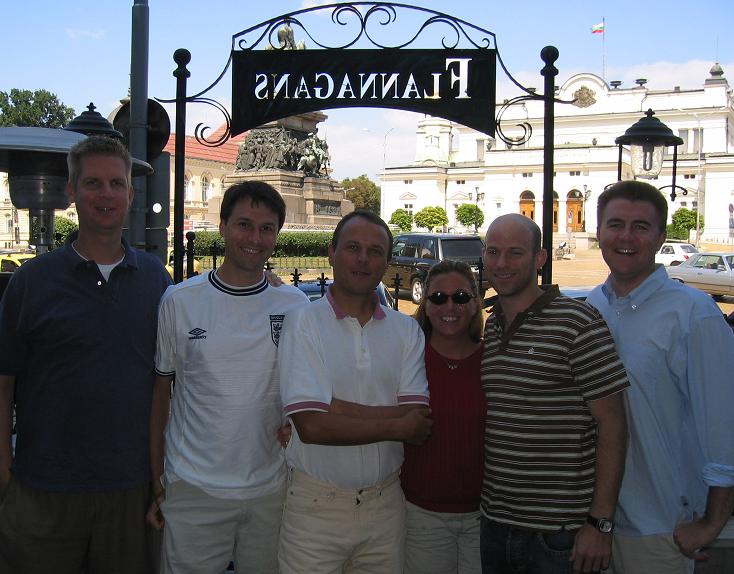
On Sunday, we had an (inexplicably German) brunch at Flannagans (Raddison Hotel) for Julia, and then another get-together that evening in advance of her returning to the USA—in fact, tonight she will already be back in her native Chicago, where she will likely be able to continue to practice her Bulgarian with cab drivers. (inside joke: Julia has a lot of colorful taxi stories from Sofia, and Chicago does indeed have a large Bulgarian population.)
Below are the men of the MBA Enterprise Corps, inconsiderate as always, standing in front of the guest of honor, Julia—the only female of the 2005 Corps—on her last day in Sofia. Thanks for putting up with us for 13 months! Left to right: Mike (formerly MBAEC in Romania), Ryan, myself, Julia, Paris, Ian (2006 Corps.) The Bulgarian national parliment is behind us.
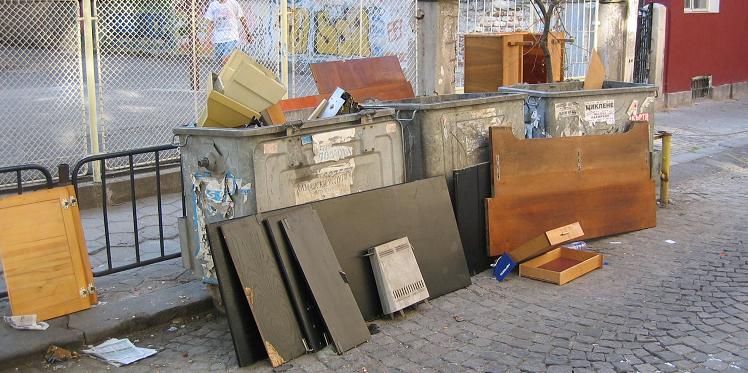 Roma would show up to scavenge recyclable metal from the junk we were brining down. Well, I quickly found out, because on the second trip, they were already there picking through the old furniture and office equipment, prying and hacking off any piece of metal for which they could get a few stotinki. Later that afternoon, I took this picture; note, the only thing left is wood and plastic—impressive.
Farewell Julia
On Sunday, we had an (inexplicably German) brunch at Flannagans (Raddison Hotel) for Julia, and then another get-together that evening in advance of her returning to the USA—in fact, tonight she will already be back in her native Chicago, where she will likely be able to continue to practice her Bulgarian with cab drivers. (inside joke: Julia has a lot of colorful taxi stories from Sofia, and Chicago does indeed have a large Bulgarian population.)
Below are the men of the MBA Enterprise Corps, inconsiderate as always, standing in front of the guest of honor, Julia—the only female of the 2005 Corps—on her last day in Sofia. Thanks for putting up with us for 13 months! Left to right: Mike (formerly MBAEC in Romania), Ryan, myself, Julia, Paris, Ian (2006 Corps.) The Bulgarian national parliment is behind us.
Subscribe to:
Posts (Atom)