As our economic woes deepen, everyone is eager to place blame at the feet of whatever nemesis his or her ideology deems fit. On the right, this entire downturn was precipitated by undisciplined and untrustworthy individuals getting sub-prime mortgages to buy homes outrageously out of their price range and then defaulting on said mortgages…triggering an avalanche that eventually lead us into the current credit crunch. Furthermore, many will claim that lenders were forced to do this because of federal “fair housing/lending” and “anti-redlining” regulations.
On the left, there is an agreement that sub-prime mortgages are at the heart of this mess, but blame is placed on the unscrupulous brokers who apparently tricked unsuspecting (and admittedly unsophisticated) homebuyers into taking risky loans just to make a quick commission, and on the “financial geniuses” who devised the now toxic “collateralized debt obligations” as well as other exotic derivatives. From this view, the whole of the rest of the cascade of events that has brought us to this point is entirely the fault of greedy (and by virtue of this unraveling—incompetent) executives, brokers, and associated “money-men.”
My view
I say there is enough blame to go around; we ALL contributed to this mess! Collectively and individually, as corporations, and governments—almost as a rule—we overextended ourselves in respect to debt; and from the most unsophisticated wage earner to the brightest minds working in the most prestigious investment firms, we all assumed that asset values, growth, and incomes would only go up. This crisis is finally the slap in the face that we all needed: we cannot borrow our way into prosperity! As the offspring of depression-era, immigrant parents, financial discipline and thriftiness was ground into me from an early age, so I have been aware of—and avoided at all costs—the trap of living beyond ones means. Never the less, I will not even hold myself blameless; I truly believe that all of us in the materialistic west have some culpability in this mess.
Reaction
No doubt, new government regulations addressing the problems that got us into this mess will be soon be put into effect; unfortunately, as backward-looking legislation, they will generally not address those issue that will eventually precipitate the next economic crisis. In fact, it is almost impossible to predict the future in this respect. The only thing we can hope for is that the laws our governments are creating will make the financial world a little more transparent; the bright light of transparency in the murky world of finance is the only reform that, in the long term, really ever works.
What I find disturbing though, is this “eat the rich” sentiment that lumps all executives and everyone in the financial industry together as greedy, incompetent, and useless. There is a disconcerting air of bolshevism in a lot of the rhetoric I’ve been hearing lately. Yes, a lot of the financial middlemen will rightly lose their jobs, and I admit that I feel a certain schadenfreude in seeing the business school colleagues who went into the finance specialty losing their lucrative positions. However it is naive to think that these functions are unnecessary and that “workers can control the means of production,” as the communist experiment of the last century disproved. We will always have executives and financiers who—by virtue of their extraordinary skills and intelligence—will demand and receive compensation commensurate with their abilities, just as highly skilled entertainers and athletes do without question.
The worst possible outcome would be the introduction of salary caps; they would most certainly be circumvented, further muddying the waters of the business and financial worlds—the opposite of what we want: transparency! Likewise, a ban on derivatives (which given the simplest definition—a bet on an underlying security—sounds like a good idea,) but would contribute more opaqueness, as these instruments would be reinvented in other forms. These exotic vehicles actually have a legitimate use: they hedge and balance other business transactions.
Bailouts
I am generally not in favour of “rescue packages” for private businesses, even large ones like General Motors that will effect dozens or hundreds of partners, thousands of employees, and maybe hundreds of thousands of others not directly employed by the company. I just have an aversion to anything that creates a distortion in the marketplace, be it subsidies, regulations, or taxes that affect one company or industry more severely than another (or, more perversely, prevents a business from entering a certain field/industry or—in the current situation—prevents it from failing/dissolving.)
That being said, I do understand why large financial institutions cannot be allowed to fail, as the resulting banking and credit crisis the would cause the entire economy grind to a screeching halt. Therefore the questions are: “how are bailout funds to be used” and “who decides how the money is used.” Specifically, whom do you trust more to “save” these firms: corporate executives—the rascals that caused (or at least contributed) the failure, or the rascals in Washington (or where ever your lawmakers/bureaucrats reside.) Quite frankly, I’m not sure of the answer myself.
Where does the money go?
On the most basic level, the problem with these troubled institutions is that their balance sheets were out of whack: their assets no longer equaled their liabilities, and therefore the government infused this money—fixing the problem. Now the question is: what happened to this bailout money? There aren’t little cubbyholes in the company’s treasury for general funds, bonus funds, electricity expenses, etc. it just become part of the company’s assets and is used in the same way that all the rest of its assets are used—fulfilling the company’s obligations to its stakeholders: investors, partners, employees, vendors, and yes—executives.
When you or I start a job, we generally negotiate or just accept a certain hourly wage or weekly to monthly salary plus a possibility of a bonus and benefits. At a certain level, these wages/salary become trivial compared to the prospect and promise of bonuses, stock options, golden parachutes, etc. Corporations must make these lucrative offers in order to hire & retain the best and brightest in the field, just as professional sports team have to offer star players multi-million dollar contracts. To those who are outraged at bonuses paid to executives at failing companies such as AIG, I ask: “where do you make the cutoff?” Imagine that you cut all bonuses and stock options for a CEO who earns a salary of $1 per year (actually very common), what is he to do? Furthermore, with this reputation, how do you expect to hire a new CEO in the future? Remember, in 1994, Ben & Jerry’s Ice Cream initially insisted that they would only pay their CEO seven times what the lowest paid employee made; despite their progressive credentials, they soon had to abandon this promise in order to find an individual of the caliber needed to guide what had become a large corporation.
Outcome
Regardless of what new regulations are enacted, we are seeing the end of the secretive back-room dealing-making that has characterized so much of the financial industry. Even if governments do nothing, the market will demand more transparency and lower costs (spreads) for financial transactions. The result will be higher returns for investors and less cost to borrowers, which of course means lower earnings for the businesses and individual that broker these transactions…and, of course, less of those high-paying financial-sector jobs.
More specifically, we will see a convergence of returns. We all know that riskier investments demand higher returns. This relationship is not punitive—it is not just to punish the reckless—it is to cover the inevitable losses that riskier investments entail. In the long-term everybody gets about the same return plus a premium proportionate with the volatility the investor must endure. What everyone has looked for was that elusive, safe investment with a higher than normal return. While there have always been a few of these, I predict that these “secret” investment will all but disappear, to the point at which we can finally say with certainty that the outliers on the risk to return graph are definitely scams (as should have been obvious with Madoff.)
The one bright spot for governments investing (and it is not just the US Federal government that is doing this) in private industry is that they are buying in at a low point; In a few years they will almost certainly have realized a substantial profit—at which time they should divest of these private concerns. It is a mistake to think that these bailouts are a gift from government to private industry; remember that Chrysler was bailed out in 1979, and by 1983 had totally repaid it 1.5 billion dollar loan to the government.
Opportunities
I find that, as individuals, this hand-wringing and finger-pointing is entirely useless; what does it help you or me to assign blame to this or that group, person, or ideology? In a time of turmoil such as now, it is prudent for a bright, young person to look around and ask, “where is this going, and where should I place myself to benefit from the inevitable changes ahead?” I really think now is the time to position oneself for the new business, regulatory, and financial climate that is coming upon us, and I am convinced that it will be characterized by more transparency—and therefore be more information-oriented, and consequently utilizing more information and communication technologies.
We have seen part of this technological revolution in finance on the personal investment front; we no longer call our broker to place a trade (from which he would take a percent or two in commission.) Instead we log on to our discount brokerage website and enter trades ourselves for a fixed $12-$15! Furthermore, on the NASDAQ stock exchange, there isn’t even a trading floor; it all takes place inside of computers. Yes, there are still brokers and market makers, but we’re definitely seeing the disintermediation of actual human beings transacting financial business. Likewise, we see that the computers of Experian, Equifax, and TransUnion (in communications with the computers of nearly all consumer credit providers) automatically determine an objective credit score for nearly every adult in America. Even loan origination (well, shopping at least) is being automated by sites such as LendingTree.com.
The ratings of corporate entities however, have long been suspect. With this crisis, we have confirmation that the stars and letter grades assigned to bonds, equities, and derivatives by the likes of Moody and MorningStar are worthless. So the obvious need is an objective system like that of the FICO (300-850) credit scores assigned individuals. I assume that someone like Dun & Bradstreet is ideally positioned to fill this need. Obviously you can’t as readily assign a single number to represent the fiscal health of a complex organization with all its divisions, subsidiaries, assets, investments, and liabilities, but together with governmental and market pressure for more transparency, I am convinced we will see the creation of one or more objective, independently audited corporate/financial rating service.
With the availability of all this data, the next obvious step is an electronic marketplace where businesses and investors can transact short and long-term lending directly without the packaging and interference of financier or their hefty commissions.
So, dear reader, if you agree with my predictions, how do you think an IT nerd with an MBA like me should position himself to catch this next wave? More specifically, where is this financial information revolution going to start—geographically and with what companies/groups? (Obviously I’m not talking about the existing and useless “financial news” industry that just speculates and rehashes earnings reports, annual reports & 10-Qs, nor the endless speculation of pundits.) I’m serious about this; I would appreciate any advice.
11 April 2009
19 December 2008
Do what you say
My parents taught me that it is better to say up front that you are not going to do something than to promise to do it and then not follow through. I use this common anecdote in explaining America's refusal to ratify the Kyoto Treaty to Europeans who brag—all high and mighty—about their commitment to reducing greenhouse gases (and, of course, imply that we—as a country—are the boorish, inconsiderate roommate of this planet.)
I've been following this issue for a while, watching as it has been becoming more and more apparent that the “first world” signatories to this treaty would not be able to live up to their promises. It seems that the EU—led by Germany—have almost totally backed out of their commitment; their “actual reductions might be as trivial as 4%” reports The Wall Street Journal.
So it looks like, collectively, we are the “good son” after all; when ask to step up to an impossible task, we simply said “sorry, we can't do it.”
I suppose the rebuttal would be: “at least Europe tried to make a difference,” to which I would ask did American business, innovators, and local government not try?
I've been following this issue for a while, watching as it has been becoming more and more apparent that the “first world” signatories to this treaty would not be able to live up to their promises. It seems that the EU—led by Germany—have almost totally backed out of their commitment; their “actual reductions might be as trivial as 4%” reports The Wall Street Journal.
So it looks like, collectively, we are the “good son” after all; when ask to step up to an impossible task, we simply said “sorry, we can't do it.”
I suppose the rebuttal would be: “at least Europe tried to make a difference,” to which I would ask did American business, innovators, and local government not try?
26 August 2008
Oil Will NEVER Get Cheaper
The sting of higher fuel prices are probably nowhere more apparent than here in the southeast US where people drive more, earn less, and define themselves by the size of their pickup trucks and SUVs. Naturally, this distress has generated all kinds of strange theories on what’s causing these unprecedented fuel prices (actually, in constant dollar terms, we are only now returning to the elevated fuel costs of the 1970s.) Everyone from the lowly gas station attendant to Saudi oil sheik to the shadowy speculator have been a target of wrath from truck owners who have just spent $100 to fill up their tank. But what really is the cause of this increase?
The answer is simple: an unprecedented increase in global demand. Prior to the last decade, the demand for fuel—and for other resources such as metals—was more or less directly related to the economies of developed, western countries. What has changed now is that the rest of the (developing) world is catching up with us. Countries formerly behind the iron curtain and throughout much of Asia, Africa, Latin America have been held back economically for decades (by corrupt and/or incompetent governments, I would argue.) Now we are seeing economic (even if not political) liberalization across the board—you can nearly count the exceptions on one hand, and even in those countries, like Cuba and North Korea, micro-enterprises are starting to flourish. Why is this happening? Because even neo-communists like Hugo Chavez and Evo Morales recognize, at least to some extent, that freer markets are the key to economic prosperity—which, incidentally is why we shouldn’t worry so much about the leftist resurgence in South America.
The economic, regulatory, and even cultural barriers that had prevented progress over so much of the developing world have been lifting in the last two decades. This freedom, in turn, has resulted in upward mobility in the population of these countries as businesses grow and trade increases. As these people—who are the majority of the 6 billion of us here on this planet—move into a sort of middle-class (by world standards at least) they begin to demand the same kind of goods that we in the west have been used to for generations: richer food, comfortable housing with modern fixtures and appliances, and even motor vehicles. [update: see this article in February 12, 2009 The Economist]
Granted, this global “middle class” cannot be compared to America’s middle class in terms of conspicuous consumption and outright waste. In fact, nobody could reasonably expect any country, industrialized, “transitioning,” or developing, to ever approach the wasteful level of energy use of Americans. However, even if the rest of the world begins to use just one-fourth of the level of resources per capita of Americans, we are looking at an incredible amount of increase in demand for everything that is mined, manufactured, and grown.
Consider Tata Motors of India; its new $2500 “Nano” 4-seater is in the price range of this emerging, third-world middle class. This means that, theoretically, there could soon be a billion (or even billions of) new cars on this planet! Compare this to the millions of cars that are sold in the west, and you will see why I think that high fuel prices are here to stay; demand has exploded, and will continue to grow at an exponential rate—a rate that supply will have a hard time to match. I realize that fuel prices have dipped back down a little in the last few months (and SUV owners are breathing a little easier,) but I am talking long-term trends here. I have yet to see anyone demonstrate how global supply of fuel or any other natural resources—for that matter—can possibly rise as fast as worldwide demand is ramping up. [2016 Update] Do-oh, I guess that I didn't have any idea about fracking in in 2008
When you look at the potential (and likely) rise in global consumption of almost any resource now, it is downright scary! Furthermore, this surge has just begun; when it comes to gasoline, California alone still uses more gasoline than any other country beside the US (Wired article.) This year, China is poised to overtake this one state in gasoline usage, but certainly not the entire US. This is both an indictment of our (and especially California’s) car culture (China has 1.1 billion inhabitants compared to California’s 36 million,) and an alarming preview of how much more of this particular resource we will needed in the future.
What is being proposed?
Everyone is looking for a silver bullet to solve this problem. There is a widespread assumption that some breakthrough is on the horizon that will save us from having to face difficult choices, and—on the fringes—there are those that think technologies are being purposely suppressed by incumbent energy companies and even governments. Whether we are talking about ethanol, bio-diesel, hydrogen fuel cells, electric cars, solar panels, or wind power, what is consistently overlooked—or perhaps omitted—are the facts regarding the lead-time for these technologies, the energy debt they require, and the simple physics that prevent some from ever becoming an effective solution.
Regardless of how revolutionary a new energy source or method of using energy more efficiently may be, it is practically impossible for such an invention to ease our energy crunch this year, or next, or even 4 years from now. Assuming you’ve invented a widget that would make all current cars twice as efficient, and it is so simple that it requires no further research and development; it would still take years to manufacture, distribute, and install this device. (Incidentally, I trust that you already know that ALL after-market gas-saving devices out here are total scams, the only way they can work is by placebo effect—you may subconsciously drive more carefully after installing one of these devices.)
Likewise, if solar panels finally crossed that magical tipping point of economic feasibility, we simply couldn’t make them fast enough to supply our energy needs because the very manufacture, transportation, and installation of these “energy saviors” would require several times more energy than they produce in a year—not to mention the all the aluminum, steel, copper, glass, silicon, and various other esoteric (and often toxic) materials used to produce solar panels. The same goes for wind power, despite this article’s assertion that offshore wind farms could produce all of America’s current electric needs, neither the article nor any of the comments below it address the energy and natural resource requirement of such a enormous project. Please don’t misunderstand me, I am not against alternative energy; I think it’s a shame that America lags Europe in this respect—places like Germany and Denmark already produce a significant percentage of their electricity by wind and solar. All that I’m saying is that this can’t happen overnight. [Update 6-Sept-08] Just found this article that show how urban wind turbines are actually bad for the environment!
Hydrogen is being touted as the ultimate in alternative fuels for vehicles, since its only emission is water vapor. However, free hydrogen does not exist on earth; it only occurs in compounds with other elements: namely with oxygen, to form water; and with carbon to form various hydrocarbons. In order to isolate hydrogen from these compounds you have to use more energy than the hydrogen can ever produce, regardless of whether it is used in a combustion engine, fuel cell, or an entirely new, revolutionary technology. These are the laws of physics that simply can’t be broken (see this article.) Therefore, all hydrogen can ever be is a method of energy storage—just like a battery. This, in turn, would require even more clean electrical power generation than mentioned in the previous scenario in order to be a truly environmentally-friendly solution.
What can’t we do?
Obviously we cannot prevent the third world from developing. I use the word “cannot” in every sense of the word; it is nearly impossible to stop the “invisible hand” of the free market from expanding these economies, certainly any coercive action to keep the third world in its previously underdeveloped state would be unthinkably immoral, and even requiring—or just encouraging—policies that would mitigate the impacts that we have experienced in our development over the last century, seem incredibly hypocritical to third world populations that now want to “test out their new wheels!” In other words, I think we have no moral authority to prevent the third world from following the path we have already taken regardless of the economic and environmental outcomes.
What needs to be done?
Depending on your background and political biases, you likely lean towards either conservation or further development of existing supplies. Certainly everyone is for developing alternative energy sources—well except for those that feel their homes or properties will be directly or indirectly effected (interesting nutcases against wind turbines.) However, I think it is obvious that we need to do all of the above. Despite the manifestly evident need for conservation, no politician is going to propose this, since it reeks of weakness (remember Jimmy Carter’s “sweater speech”?) Thankfully, the market will take care of this…which brings me to my next point.
What will happen?
What will happen is that the market self-corrects. Naturally, as the demand for something increases, the price does as well—thereby tempering the demand while, at the same time, encouraging greater production of said resource and its substitutes (alternative energy in our case.) This is why it is so important that our leaders do nothing to distort the market. McCain and Clinton’s proposed gas tax holiday was just such a bone-headed idea: it would have softened the very necessary market signals that tell us, as consumers, to reign in our consumption and producers (including alternative energy upstarts) to ramp up production, exploration, research, and development. Likewise, incentives to produce ethanol from corn, which is horribly inefficient, has proven to be a boondoggle that nobody but Iowa corn growers benefit from.
The other option is to introduce a dizzying array of counter-balancing regulations, taxes, and subsidies: laws and incentives to force individual and industrial consumers to conserve artificially inexpensive resources plus incentives and outright subsidies to producers to increase production and develop new sources despite a price that is too low to make an economic case for such investments. These prohibitions and inducements would, of course, be gamed by all sides despite legions of bureaucrats to administer it all!
I have been planning to write and publish the post for some months now. What has happened in those intervening months seems to counter my thesis that fuel prices will remain high indefinitely. The reason that fuel prices have fallen (slightly) this summer is that demand has slumped—bringing about the concept of a “staycation” for instance, and production has risen—Canadian oil sands are now economically feasible for example. However, as I’ve said before, this is a temporary dip; the pent-up demand for fuel and other resources in the developing world will only continue to rise, negating the effect of all our conservation efforts. Furthermore, the higher cost producers require to maintain new sources such as marginal oil wells or oil sands means that we can never get back to the prices of the previous decades unless worldwide demand commensurately shrinks to that time as well, idling these more expensive resources. (Interesting CNN article about this)
We simply need to get it through our thick skulls that energy will never again be as cheap as it used to be. The recent rise in fuel prices is not an anomaly that will quickly pass; oil (and other natural resources) are indeed scarce enough to demand these prices (not to mention yet unknown cost of environmental impacts of using said resources.) We now need to reorganize our lives and communities to deal with this new reality. Ever the optimist, I actually think that—for the most part—we are learning this. For example, even the gearheads at Motor Trend are admiring compact, fuel efficient European cars.
[Update – March 2009] With gas still under $2/gallon, and no sight of a serious economic recovery in the near future (necessary for demand to rise,) one might think that I would want to retract this post. However, I stand by everything I have written here last year. I am confident that, in the long-term, I will be vindicated in saying this is just a temporary dip in the price of fuel. No one knows how long this recession will last, and even after a recovery there will be a surplus of oil that has been cached all around the world during this period of low demand. Never the less, I challenge anyone to claim the following is bad advice: “Do not allow your local car dealer to convince you that now is a good time to buy a gas-guzzling SUV or truck because gas prices are going to stay low. Within the service life of any new vehicle you buy now (let’s say around 5 years,) gas will rise back up to the $4-$5 per gallon range.”
[2016 Update] OK, I give up. I was wrong. Largely as a result of the fracking revolution, America suddenly has more oil than it needs. However, I still would not buy an SUV; regulatory pressure and long-suppressed uptick in resource demands from the developing world still loom in our future.
The answer is simple: an unprecedented increase in global demand. Prior to the last decade, the demand for fuel—and for other resources such as metals—was more or less directly related to the economies of developed, western countries. What has changed now is that the rest of the (developing) world is catching up with us. Countries formerly behind the iron curtain and throughout much of Asia, Africa, Latin America have been held back economically for decades (by corrupt and/or incompetent governments, I would argue.) Now we are seeing economic (even if not political) liberalization across the board—you can nearly count the exceptions on one hand, and even in those countries, like Cuba and North Korea, micro-enterprises are starting to flourish. Why is this happening? Because even neo-communists like Hugo Chavez and Evo Morales recognize, at least to some extent, that freer markets are the key to economic prosperity—which, incidentally is why we shouldn’t worry so much about the leftist resurgence in South America.
The economic, regulatory, and even cultural barriers that had prevented progress over so much of the developing world have been lifting in the last two decades. This freedom, in turn, has resulted in upward mobility in the population of these countries as businesses grow and trade increases. As these people—who are the majority of the 6 billion of us here on this planet—move into a sort of middle-class (by world standards at least) they begin to demand the same kind of goods that we in the west have been used to for generations: richer food, comfortable housing with modern fixtures and appliances, and even motor vehicles. [update: see this article in February 12, 2009 The Economist]
Granted, this global “middle class” cannot be compared to America’s middle class in terms of conspicuous consumption and outright waste. In fact, nobody could reasonably expect any country, industrialized, “transitioning,” or developing, to ever approach the wasteful level of energy use of Americans. However, even if the rest of the world begins to use just one-fourth of the level of resources per capita of Americans, we are looking at an incredible amount of increase in demand for everything that is mined, manufactured, and grown.
Consider Tata Motors of India; its new $2500 “Nano” 4-seater is in the price range of this emerging, third-world middle class. This means that, theoretically, there could soon be a billion (or even billions of) new cars on this planet! Compare this to the millions of cars that are sold in the west, and you will see why I think that high fuel prices are here to stay; demand has exploded, and will continue to grow at an exponential rate—a rate that supply will have a hard time to match. I realize that fuel prices have dipped back down a little in the last few months (and SUV owners are breathing a little easier,) but I am talking long-term trends here. I have yet to see anyone demonstrate how global supply of fuel or any other natural resources—for that matter—can possibly rise as fast as worldwide demand is ramping up. [2016 Update] Do-oh, I guess that I didn't have any idea about fracking in in 2008
When you look at the potential (and likely) rise in global consumption of almost any resource now, it is downright scary! Furthermore, this surge has just begun; when it comes to gasoline, California alone still uses more gasoline than any other country beside the US (Wired article.) This year, China is poised to overtake this one state in gasoline usage, but certainly not the entire US. This is both an indictment of our (and especially California’s) car culture (China has 1.1 billion inhabitants compared to California’s 36 million,) and an alarming preview of how much more of this particular resource we will needed in the future.
What is being proposed?
Everyone is looking for a silver bullet to solve this problem. There is a widespread assumption that some breakthrough is on the horizon that will save us from having to face difficult choices, and—on the fringes—there are those that think technologies are being purposely suppressed by incumbent energy companies and even governments. Whether we are talking about ethanol, bio-diesel, hydrogen fuel cells, electric cars, solar panels, or wind power, what is consistently overlooked—or perhaps omitted—are the facts regarding the lead-time for these technologies, the energy debt they require, and the simple physics that prevent some from ever becoming an effective solution.
Regardless of how revolutionary a new energy source or method of using energy more efficiently may be, it is practically impossible for such an invention to ease our energy crunch this year, or next, or even 4 years from now. Assuming you’ve invented a widget that would make all current cars twice as efficient, and it is so simple that it requires no further research and development; it would still take years to manufacture, distribute, and install this device. (Incidentally, I trust that you already know that ALL after-market gas-saving devices out here are total scams, the only way they can work is by placebo effect—you may subconsciously drive more carefully after installing one of these devices.)
Likewise, if solar panels finally crossed that magical tipping point of economic feasibility, we simply couldn’t make them fast enough to supply our energy needs because the very manufacture, transportation, and installation of these “energy saviors” would require several times more energy than they produce in a year—not to mention the all the aluminum, steel, copper, glass, silicon, and various other esoteric (and often toxic) materials used to produce solar panels. The same goes for wind power, despite this article’s assertion that offshore wind farms could produce all of America’s current electric needs, neither the article nor any of the comments below it address the energy and natural resource requirement of such a enormous project. Please don’t misunderstand me, I am not against alternative energy; I think it’s a shame that America lags Europe in this respect—places like Germany and Denmark already produce a significant percentage of their electricity by wind and solar. All that I’m saying is that this can’t happen overnight. [Update 6-Sept-08] Just found this article that show how urban wind turbines are actually bad for the environment!
Hydrogen is being touted as the ultimate in alternative fuels for vehicles, since its only emission is water vapor. However, free hydrogen does not exist on earth; it only occurs in compounds with other elements: namely with oxygen, to form water; and with carbon to form various hydrocarbons. In order to isolate hydrogen from these compounds you have to use more energy than the hydrogen can ever produce, regardless of whether it is used in a combustion engine, fuel cell, or an entirely new, revolutionary technology. These are the laws of physics that simply can’t be broken (see this article.) Therefore, all hydrogen can ever be is a method of energy storage—just like a battery. This, in turn, would require even more clean electrical power generation than mentioned in the previous scenario in order to be a truly environmentally-friendly solution.
What can’t we do?
Obviously we cannot prevent the third world from developing. I use the word “cannot” in every sense of the word; it is nearly impossible to stop the “invisible hand” of the free market from expanding these economies, certainly any coercive action to keep the third world in its previously underdeveloped state would be unthinkably immoral, and even requiring—or just encouraging—policies that would mitigate the impacts that we have experienced in our development over the last century, seem incredibly hypocritical to third world populations that now want to “test out their new wheels!” In other words, I think we have no moral authority to prevent the third world from following the path we have already taken regardless of the economic and environmental outcomes.
What needs to be done?
Depending on your background and political biases, you likely lean towards either conservation or further development of existing supplies. Certainly everyone is for developing alternative energy sources—well except for those that feel their homes or properties will be directly or indirectly effected (interesting nutcases against wind turbines.) However, I think it is obvious that we need to do all of the above. Despite the manifestly evident need for conservation, no politician is going to propose this, since it reeks of weakness (remember Jimmy Carter’s “sweater speech”?) Thankfully, the market will take care of this…which brings me to my next point.
What will happen?
What will happen is that the market self-corrects. Naturally, as the demand for something increases, the price does as well—thereby tempering the demand while, at the same time, encouraging greater production of said resource and its substitutes (alternative energy in our case.) This is why it is so important that our leaders do nothing to distort the market. McCain and Clinton’s proposed gas tax holiday was just such a bone-headed idea: it would have softened the very necessary market signals that tell us, as consumers, to reign in our consumption and producers (including alternative energy upstarts) to ramp up production, exploration, research, and development. Likewise, incentives to produce ethanol from corn, which is horribly inefficient, has proven to be a boondoggle that nobody but Iowa corn growers benefit from.
The other option is to introduce a dizzying array of counter-balancing regulations, taxes, and subsidies: laws and incentives to force individual and industrial consumers to conserve artificially inexpensive resources plus incentives and outright subsidies to producers to increase production and develop new sources despite a price that is too low to make an economic case for such investments. These prohibitions and inducements would, of course, be gamed by all sides despite legions of bureaucrats to administer it all!
I have been planning to write and publish the post for some months now. What has happened in those intervening months seems to counter my thesis that fuel prices will remain high indefinitely. The reason that fuel prices have fallen (slightly) this summer is that demand has slumped—bringing about the concept of a “staycation” for instance, and production has risen—Canadian oil sands are now economically feasible for example. However, as I’ve said before, this is a temporary dip; the pent-up demand for fuel and other resources in the developing world will only continue to rise, negating the effect of all our conservation efforts. Furthermore, the higher cost producers require to maintain new sources such as marginal oil wells or oil sands means that we can never get back to the prices of the previous decades unless worldwide demand commensurately shrinks to that time as well, idling these more expensive resources. (Interesting CNN article about this)
We simply need to get it through our thick skulls that energy will never again be as cheap as it used to be. The recent rise in fuel prices is not an anomaly that will quickly pass; oil (and other natural resources) are indeed scarce enough to demand these prices (not to mention yet unknown cost of environmental impacts of using said resources.) We now need to reorganize our lives and communities to deal with this new reality. Ever the optimist, I actually think that—for the most part—we are learning this. For example, even the gearheads at Motor Trend are admiring compact, fuel efficient European cars.
[Update – March 2009] With gas still under $2/gallon, and no sight of a serious economic recovery in the near future (necessary for demand to rise,) one might think that I would want to retract this post. However, I stand by everything I have written here last year. I am confident that, in the long-term, I will be vindicated in saying this is just a temporary dip in the price of fuel. No one knows how long this recession will last, and even after a recovery there will be a surplus of oil that has been cached all around the world during this period of low demand. Never the less, I challenge anyone to claim the following is bad advice: “Do not allow your local car dealer to convince you that now is a good time to buy a gas-guzzling SUV or truck because gas prices are going to stay low. Within the service life of any new vehicle you buy now (let’s say around 5 years,) gas will rise back up to the $4-$5 per gallon range.”
[2016 Update] OK, I give up. I was wrong. Largely as a result of the fracking revolution, America suddenly has more oil than it needs. However, I still would not buy an SUV; regulatory pressure and long-suppressed uptick in resource demands from the developing world still loom in our future.
17 July 2008
You can’t sing that, it’s my song!
I suppose the story is the same between young siblings and/or cousins in families across the world: a mother teaches her son or daughter a song, and the child takes ownership of the song to such an extent that you eventually hear something to the effect of: “You can’t sing that song, it’s my song!” when an older sibling (or cousin, or even uncle) provokes the little one by daring to sing his or her song.
Déjà vu
It’s all very cute for small children, but we wouldn’t expect to see this kind of childish behavior among adults, and especially in the NGO world where everything is supposedly for the greater benefit of mankind. So it was with great interest that I read these recent articles about the explosion in commercial microfinance (positive and negative ) in BusinessWeek.
Microlending (a.k.a. micro-loans) have been the bailiwick of non-governmental development organizations (NGOs); I would goes so far as to say they have been the single, most effective use of these organizations’ funds. Their funding, which can come from a number of public and private sources, is given with the explicit or implicit stipulation that they will be used to help needy people of the underdeveloped world. Prior to Muhammad Yunus’s revolutionary idea of making tiny—by our standards—loans to poverty-stricken entrepreneurs in the developing world, development funds were generally either given to the governments of these developing countries, or used by the in-country aid agencies.
Of course, direct payments to a 3rd world government or its associates does about as much good to the suffering people of in their country as wiring the money directly into their leaders’ personal bank accounts, because that is where most of it ends up anyway. Assuming this is an unfairly harsh characterization, at the very least and by virtue of the underdeveloped state of their economy, the policies put in place by these governments (of course it is always the previous regime’s fault) demonstrate that, collectively, the government is horribly incompetent—therefore, a direct payment is throwing good money after bad.
On the other extreme, you can send in your own people to administer the disbursement of these funds, but regardless of how idealistic they are, if they are intelligent, competent and successful, they will need to be properly compensated and will require a nice home with western amenities, an office with air conditioning, and a Land Rover to negotiate the poor roads. Besides eating away a good portion of the funding—ultimately intended for the suffering population you are trying to help—this also causes a certain amount of resentment from local staff and the population in general.
Regardless of which method you choose, you will only be able to help a small number of individuals or businesses in any particular country. This is the simple reality of the situation: the need is great, but your budget is limited—even if you have the backing of someone like USAID (the US government) or UNDP (the UN.) This, in turn, creates “islands” of development aid. While these “islands” usually have a geographic characteristic (concentrated around the capital and other major cities) it more accurately describes the network of people that are “in” the development community; in other words, those that get the help do so because they know people, know how to fill out a grant application, etc. Those that are outside of this “island” have little chance of getting any help (either monetary or technical), and again this is regardless of the idealistic and egalitarian intent the program may have been set up with—this is just how it work; some get seconds before equally deserving entities get anything.
Returning to the topic of microfinance, this is generally a wonderfully effective use of development funds. The purpose of each loan is to create or expand the business of a desperately under-served entrepreneur/small businessman—giving them something, even if only a subsistence job, where before was absolutely nothing. In effect, each loan is a direct, targeted (albeit very small) aid package to an individual, family, or small business that would otherwise have no access to capital due to a total lack of credit history, collateral, or any other traditional way to demonstrate creditworthiness. Incredibly, micro-loans—as they’ve been administered—have a surprisingly high repayment rate. This means that as loans are paid back (and with interest) this money can be lent out again and again—eventually benefiting many more people than any other development program could do with the same amount of money. Microlending has deservedly become popular throughout the development community; even the smallest NGOs and religious organizations are getting into the game. Since you are already on the Internet, you can even surf on over to kiva.org and make you own micro-loan!
Naturally, financial institutions have woken up to this lucrative market, and entered the mix. Now some in the NGO world, especially Mr. Yunus, are crying “foul!” However, in practice, the high ideals of people who say that we should not make money from the poor in this way are simply limiting the opportunities of a vast population who are simply not “connected” enough to be one of the few, lucky ones who gets a loan from an NGO. Regardless of their intent—in my mind at least—they come out looking like the child who says, “you can’t sing my song” or, worse the hood who says, “hey, that’s my turf!” The whole purpose of micro-finance is to provide capital to previously underserved populations; now that traditional players are doing so, Mr. Yunus and the rest of the NGO community should pat itself on the back for making a real, effective change in the world instead of worrying about their own turf.
Granted, part of their complaint is that these for-profit entities charge too much interest, but as more commercial players enter the market, the interest rate will naturally settle to a level commensurate with the risk of such loans. We know from basic economics that the riskier an investment, the higher interest (or other form return) that will be expected. This risk/reward curve gets a little discontinuous at the extreme where defaults are very common, but let’s remember that even the slimiest payday lender is providing credit to someone who has no other alternatives.
Likewise, I am concerned about the Mexican big-box retailers mentioned in this article that are marketing the western “have it now, pay later” lifestyle that may cause more harm than good to these desperately poor people; but who am I to say that only I and my fellow middle-income earners of the world should be allowed to have these modern conveniences? In this regard, concerns about payday/title loan sharks in the US and questionable lenders in the developing world both result in a very paternalistic view of the “great unwashed masses” of the world—which I am willing to concede is sometimes warranted, but doesn’t have a place in discussions of a free market.
Déjà vu
This issue reminds me of a very similar complaint last year from Nicholas Negroponte of the One Laptop Per Child project. (WSJ article) He was whining that Intel, Microsoft, HP, et al were chipping away at his non-profit’s business after he and his brilliant team from MIT developed the versatile and inexpensive (although never quite reaching the promised $100 price point) XO computer for underprivileged children across the world. Again, he should have simply declared victory—these huge incumbent companies are now making low-cost computers to fill a previously underserved market: the developing world. Instead he questioned their motivations—namely that they were just temporarily lowering their prices to get the developing world hooked on the WinTel platform (instead of his open-source platform.)
Disclaimer: This is in no way an indictment of any organization that I have been associated with, rather it is a general observation of international development efforts that I've seen during my stint in this field and from my continued interest in this area since then.
25 June 2008
New material
I know I’ve said this before, but The Persistent Itch is back! I’ve missed having the recurring surge of creativity and intellectual stimulation required for coming up with a new posts for this blog. The following ideas have been bouncing around in my head for a while, and I am now committed to start writing posts beginning with these subject.
On the computer front, I have a new laptop—with which I am writing this right now—the diminutive Asus eee series 900. It’s a great little computer that attracts attention wherever I go and does 90% of what I need it to do—all for just a little over $500! Despite its ultra-portable form-factor, I actually don’t drag it around with me most of the time because I have a computer in my pocket that lets me surf the web, check my email, or jot down a note—the Apple iPhone. Thanks to Ziphone.org I didn’t have to sign up for the pricey AT&T data plan—especially since the EDGE (GPRS) data network is so slow it’s practically unusable.
Red Bank Hydro
After a nearly year-long lull in this project, the motor/generators were finally installed earlier this year, and as of 21 May 2008, we are officially making power! Unfortunately, this coincided with a drought period here in South Carolina, meaning we are only able to generate a fraction of this plant's potential, and only during the peak hours of 12:00-22:00. I have been gradually designing and installing progressively more sophisticated controls; the next step is to install a water level transducer and program the PID functionality of the PLC to ride the level of the lake. YouTube video
Twitter
As if blogging is not enough of a chore, I signed up for “Twitter” the micro-blogging (140 character maximum—for SMS) service. I did it only to secure http://twitter.com/froese but who knows, I might occasionally throw some status updates out there, so follow me if you have an account; in any case, I’m adding the feed to the right hand column here.
- World Resource Allocation
- Islam’s Last Gasp
- Fair Trade
- Local Food
- Gift-o-marketing complex
- Personal investing strategies
- Save by NOT buying at all!
Who is to blame for ever increasing fuel and food costs? Bush, OPEC, speculators? No, actually the proverbial “starving child in China” and others in the developing world are “at fault” for trying live the life we in the west are accustomed to—and therefore we can’t really blame them.
Terrorist training camps in Afghanistan, refugee unrest in and around Israel, Al-Qaeda in Iraq, the rise of Islamic parties in Egypt and Turkey, and even riots in France and England seem to point to a rising tide of Islamic extremism around the globe. However, I posit that this is actually fundamentalist Islam’s last gasp; an overwhelmingly young demographic in most predominantly Muslim countries are actually yearning for western products, music, and popular culture; those young people that are embracing extremist Islam are actually a tiny minority.
Juan Valdez gets an extra fifty cents per bag of coffee, which is great, but if I have to pay an extra three dollar to give him this fifty cents, is is really worth it? I suspect that, due to the less efficient supply chains of “sustainable, fair trade” companies, Juan gets a smaller percentage of my purchase price when I buy “fair trade.”
For all the talk of “food miles,” I suspect that a carrot shipped 500 miles in a Wal-Mart tractor-trailer (that is packed to the roof) actually has a smaller carbon footprint than the carrot brought 50 miles into town by the friendly, local organic farmer in his pickup truck or box van.
Just as there may be sinister military/industrial complex convincing our leaders in the White House and Congress to buy, buy, buy expensive new weapon systems, associated goods, and services, there is a very real and sinister force that is influencing us to buy and gift items to friends, family, and acquaintances for an ever-increasing number of holidays and special occasions. I would not be surprised that within the next generation these marketers will have convinced Americans that it would be socially unacceptable to not exchange Arbor Day gifts among friends and family.
They say to build wealth, start an investment account with as little as $500; while I understand the sentiment, I think it’s downright stupid with for someone with $5000 or more of credit card debt—which is most Americans.
While this concept is so obvious that I can’t imagine needing to expound on it, apparently a lot of people don’t seem to understand that unless you really need/require something, in the long run you will be happier and more prosperous by delaying or even denying yourself the purchase of unnecessary goods—more of my minimalist philosophies.
On the computer front, I have a new laptop—with which I am writing this right now—the diminutive Asus eee series 900. It’s a great little computer that attracts attention wherever I go and does 90% of what I need it to do—all for just a little over $500! Despite its ultra-portable form-factor, I actually don’t drag it around with me most of the time because I have a computer in my pocket that lets me surf the web, check my email, or jot down a note—the Apple iPhone. Thanks to Ziphone.org I didn’t have to sign up for the pricey AT&T data plan—especially since the EDGE (GPRS) data network is so slow it’s practically unusable.
Red Bank Hydro
After a nearly year-long lull in this project, the motor/generators were finally installed earlier this year, and as of 21 May 2008, we are officially making power! Unfortunately, this coincided with a drought period here in South Carolina, meaning we are only able to generate a fraction of this plant's potential, and only during the peak hours of 12:00-22:00. I have been gradually designing and installing progressively more sophisticated controls; the next step is to install a water level transducer and program the PID functionality of the PLC to ride the level of the lake. YouTube video
As if blogging is not enough of a chore, I signed up for “Twitter” the micro-blogging (140 character maximum—for SMS) service. I did it only to secure http://twitter.com/froese but who knows, I might occasionally throw some status updates out there, so follow me if you have an account; in any case, I’m adding the feed to the right hand column here.
16 August 2007
Hrvatska
Here it is finally…the promised account of my sailing trip in Croatia with my girlfriend Mirena, Mike (fellow MBA Enterprise Corps alumi), his girlfriend Melinda, and his (and now mine as well) other friends: David, Marta, Ken, and Crystal.
Day 1 – Split
Our group convened at the Split airport where we tried to keep our driver from leaving before all eight of us were in the van. During peak vacation time (read: July and August) this little airport is overcrowded with holiday-makers from all over Europe, meaning there is no room to park (hence our driver wanted to leave) and little room on the tarmac for airplanes (which is why our last crew-member was still circling the skies above us.) The rest of the ride to the marina was uneventful until the last 500 meters, which although being a two-way road, was only one lane wide. This meant that at nearly every attempt our driver made, he could never make it to the halfway point or otherwise force the oncoming traffic to back up (incidentally, I had the same experience driving in Sofia the following week.)
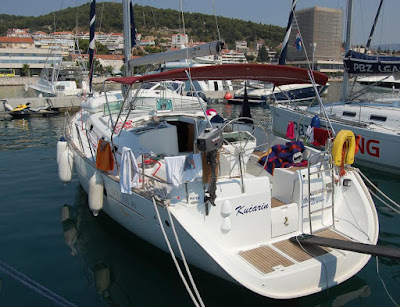 This first day we did not even cast off lines; the afternoon was spent provisioning (which entailed pushing grocery carts full of food for over 1 km), briefing, and familiarization for our boat, an Océanis 411 called the Kučarin (pronounced “Koochareen”.) In the evening, we took a water taxi to the old town, which was interesting, but I didn’t want to spend too much time there as I was still trying to catch up the sleep I had recently missed.
Day 2 – Split to Brač Island
It seems none of my crew-members are morning people, so generally we got underway around 10 or 11 every day. After tacking back and forth into the wind most of the afternoon, we decided that Brač Island was far enough, and anchored in a secluded yet crowded cove that featured two primitive, outdoor restaurants (where we would eat that evening.)
The funniest thing to happen this day occurred as we were trying to anchor. On the stern of a neighboring boat there were two completely naked, young women (we assume they were German) frolicking in the water; in fact, one of them got on a pool raft and briefly got in our way as we were laying down the anchor chain. If only I had my camera at hand (and not been busy at the windlass,) I would have photographic proof of this distraction for you now. ;-)
Mirena was happy to be back on solid ground again, so we hiked over the hill to the little, sea-side town of Milna, which was pleasant but unremarkable by Dalmatian standards as we would find out later in the week; every town, village, and burg on these islands is an idyllic, old fishing village.
Day 3 – Sail to Vis
We left our little cove on Brač and sailed most of the day on a single, south-westerly tack in moderate winds to the island of Vis. Here we found Komiža, the town, harbour, and pebbled beach where we anchored, and which would later be the cause of all our problems.
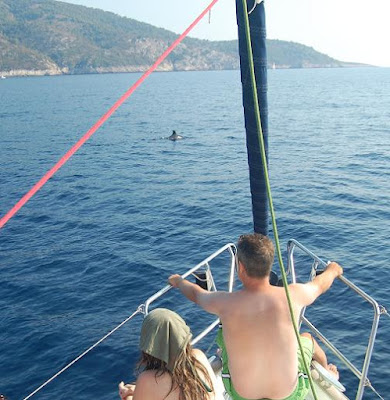
Mirena and Ken watch dolphins from the bow near Vis
Although it was almost evening, some of us swam a little bit before getting ready for dinner, as tonight turned out to be “date night” and each couple found their own restaurant in Komiža. Our group (including David, Marta, Mirena, and myself) returned to the boat first, even after traipsing all over this little town and having dinner. David and I were sitting in the cockpit watching our boat and others being blown around by the strengthening “bora” winds that were coming off the mountains in front of us and wondering if we were getting closer to the anchor buoy of the boat behind us. You have to understand that a boat will move a little in wind and waves even when anchored securely—which is, of course, disconcerting.
We did indeed lose anchorage, and David and I were forced to haul up the anchor (partly manually because the windlass circuit breaker kept tripping.) At the same time, Mike and the rest of our crew attempted to reach us with the dingy (by now we had drifted almost 1 km downwind.) Eventually we got the anchor up and motored back into the harbour where Mike had found a British guy on a similar sailing yacht who helped us out and showed us how to how to rig two anchors in series, which he said should be good for winds up to 100 knots! This being done, I felt secure and went to get some shut-eye, while the rest of the crew stayed up nervously monitoring our movement in the still increasing “bora” winds.
I guess it was an hour later when I was awoken, told to put on a life vest, and assist on deck as our anchorage had either failed or been pulled up by another nearby boat’s failed anchorage. The skies were dark, the winds were howling, and other boats whose anchorage had also failed were motoring about the harbour seemingly not knowing what to do. Mike was at the helm trying to avoid other boats and make it easier for David and Ken to manually crank the anchor chain back up (the tension on the chain prevented us from using the windlass for more than a few second before the breaker would trip—which was Melinda’s job to reset, since the breaker was in her cabin; we later joked that we would call her up unexpectedly at night and tell her “reset the breaker” just so she could relive this exciting time!) We suspected that our anchor had become entangled with another boat’s anchor (specifically the British guy who had helped us earlier,) and that indeed became apparent as we reeled in the final 10m of chain. Imagine the scene: 2 boat, each over 40 feet long, attached bow-to-bow, spinning slowly around each other as if in an lumbering dance, as we both slowly reeled in our anchors. We finally got the first anchor up, and David heroically leaned over the bow railing to untangle our friend's anchor chain—we were finally free! Disgusted with our experience in Vis, we intended to sail through the night to our next destination. This turned out to be foolhardy in these less-than-ideal conditions, so we head back and anchored closer to shore. This third anchorage was successful, and the rest of the night (what little was left) was uneventful.
Day 4 – Blue Grotto, Vela Luka
In the morning, we were able to pull into one of the coveted marina slips in Vis to refill our totally empty fresh water tanks. Had this slip been available the previous evening, we would have been well rested, and not had any of the adventures of the previous night. We had a long day of sailing planned, but decided that we had to see the famous “Blue Grotto” on Biševo Island. This is a sea cave with a fairly large chamber and two openings: one long, narrow opening that can be negotiated by a dingy, and another short one that is underwater, and gives the chamber its namesake blue hue. It took two trips for everyone to see it, but was definitely worth it.

The Kučarin getting water at marina in Vis
The rest of the afternoon was spent sailing almost directly downwind in heavy seas; this was both fun/satisfying (we hit 9 knots) and—for the ladies—a little disconcerting since the boat would pitch and roll in every direction as 2 meter waves would overtake us from the stern.
We originally intended to sail to Korčula Town, but—as the light was waning—decided to pull into Vela Luka on the near side of the same island. Vela Luka was indeed a great harbour as its name suggests, but it is not the renowned fortress town of Korčula we wanted see. Never the less, we had a nice meal and managed to catch a folk dance exhibition in the town square.
Day 5 – Lumbarda, Korčula
The next morning we immediately set sail—well, after Mike got his requisite cappuccino—for Korčula. We arrived in the early afternoon only to find that the marina was full. Continuing on to the next little town, Lumbarda, we found that their slips were also either occupied or reserved. We had promised ourselves that, at this halfway point, we would treat ourselves to a marina, where we could get a real shower, shore power to recharge phones/cameras, and not have to be ferried to/from shore by dingy every time. For this reason, Mike became very persistent—circling our boat in front of the marina’s docks until they agreed to let us “just refill our water tanks.” With this foot-in-the-door, our crew was eventually able to secure us the slip for the night.
Clockwise from left: Marta, Crystal, Ken, Mike, and David enjoying drinks near Lumbarda marina
Day 6 – Korčula to Mljet
Unlike previous days, we planned to stay on this island for most of the day. Most of us rented scooters to get to Korčula town and explore the rest of the island. Mirena and I set off eastward on a road that followed the coast and revealed all the little coves and idyllic sea-side towns along the way—one of which we would stop for lunch, and have one of the best meals of the trip. Despite being an under-powered scooter, Mirena insisted I was driving too fast, so I let her drive, and—by the end of the day—she had become quite competent at negotiating a scooter with two people on it over narrow, twisting roads.


The village of Kneže, where we ate our best lunch

The historic town of Korčula
By 19:00 we were all back on board and ready to sail on to Mljet—an island comprised mainly of national park. We had planned this to be the evening that we would eat onboard instead of going to a restaurant, and preparations were going on below deck as wesailed…err motored into the evening. As we approached the island, it was totally dark, so we had to rely solely on the GPS; unfortunately, this was located below deck, so I had to call out headings and distances to Mike at the helm—it was actually quite amazing, this would not have been possible on a pleasure craft this size before the GPS era. We expected to find a desolate anchorage, but instead circled magnificent yachts before anchoring with in sight (and earshot) of a small town inside the nation park. As we ate our dinner, we were serenaded by a saxophone player whose music carried over the water on this calm evening.
Day 7 – Mljet, Lopud, Dubrovnik marina
This final day of sailing was going to be a long one; we needed to cover the remaining distance to Dubrovnik, since we were now a day behind schedule. Still, we made a beer stop, a stop for swimming, and stopped on Lopud for dinner. As we were finishing up our Prošek, a stiff wind blew into town, and we knew that we needed to get back on the boat quickly in order to continue down the coast to Dubrovnik and hopefully outrun the approaching storm—which we did. Although it was night, and there was lightning flashing across the sky behind us, we were reassured to see the lights of Dubrovnik in the distance. Soon enough we were under the Tuđman Bridge, and aside from one final incident, found ourselves safely berthed at ACI Marina for our final night on the Kučarin.

Ken, Crystal (hidden), David, Melinda (at helm), Mike, and Mirena in the cockpit of Kučarin somewhere in the Adriatic Sea
Day 8 – Dubrovnik
We had to leave the boat by 9:00 (which of course dragged out another hour plus,) and our flight back to Vienna left at 15:00. This meant we could only hit the highlights in Dubrovnik—which is an amazing city, and deserves a lot more time. Along with Marta, whose flight was also leaving around the same time, we made our best effort to see as much of the Stari Grad (old town) as possible in one afternoon. Unfortunately, after 813 photos, the battery on my camera ran out, so here is a picture taken with Mirena’s camera phone.
Evaluation: This was my third sailing trip, and probably my favourite. Last year I sailed in Turkey (also with Mike) and the Caribbean with my family. What the Dalmatian Coast lacks in sandy beaches and coral reefs, it more than makes up for in its ports of call. Being the Mediterranean coast, it reminded me a lot of Turkey, but what was missing in Turkey was the living sense of history that is pervasive in Croatia. Both countries have undergone conflicts in recent history, but—although Croatia’s war was just a decade ago—it has been all patched up and its towns have a sense of timelessness more like those in Italy or Spain.
Mirena prefers snorkeling in warm Caribbean waters and missed having a sandy beach, but back on land—aside from the natural beauty (which is sometimes hard to find)—the Caribbean simply lacks the millennia of civilization that is infused throughout the entire perimeter of the Mediterranean Sea. I am convinced that a day poking around the shore anywhere in this, the hub of ancient trade would yield at least a shard of antique pottery. And, as students of western civilization, many of the stories we already know took place in this region; the island of Mljet, for example, is a more probable location of the apostle Paul’s shipwreck than the traditional site of Malta, and Homer’s Odysseus is also rumored to have visited this island.
 Notes on pronunciation: Serbo-Croatian, which despite protestations from Mirena and Marta, is indeed is the common language of Serbia, Bosnia, and Croatia—each have their own dialect that they insist is a separate language. On the Dalmatian Coast, and especially farther north in Istria, this language is spoken with a distinctly Italian cadence; without listening to the words, (many of which are recognizable to Bulgarian speakers) I could have sworn they were speaking a Romance language.
What really throws most people off though, is the elimination of the vowel “uh” in writing (both in the Latin and Cyrillic alphabets,) so if you see too many consonants in a row, throw an “uh” in there (especially before an “r”) to make it pronounceable. On this subject, you must read this humorous take that I originally thought Dave Barry wrote, but can't seem to find an attribution: Operation Vowel Drop
Pronounce most of the letter as you would expect with these exceptions: J is soft (“y”) like in German, C is always ‘ts’ as in Cincinnati, Č is ‘ch’, Š is ‘sh’, Ž is usually written ‘zh’ and pronounced like the ‘s’ in “measure”, Đ is our ‘j’; vowels—of course—are European: A=‘ah’, E=‘eh’, I=‘ee’, O=‘oh’, U=‘oo’...oh, and roll your R!

Day 1 – Split
Our group convened at the Split airport where we tried to keep our driver from leaving before all eight of us were in the van. During peak vacation time (read: July and August) this little airport is overcrowded with holiday-makers from all over Europe, meaning there is no room to park (hence our driver wanted to leave) and little room on the tarmac for airplanes (which is why our last crew-member was still circling the skies above us.) The rest of the ride to the marina was uneventful until the last 500 meters, which although being a two-way road, was only one lane wide. This meant that at nearly every attempt our driver made, he could never make it to the halfway point or otherwise force the oncoming traffic to back up (incidentally, I had the same experience driving in Sofia the following week.)
 This first day we did not even cast off lines; the afternoon was spent provisioning (which entailed pushing grocery carts full of food for over 1 km), briefing, and familiarization for our boat, an Océanis 411 called the Kučarin (pronounced “Koochareen”.) In the evening, we took a water taxi to the old town, which was interesting, but I didn’t want to spend too much time there as I was still trying to catch up the sleep I had recently missed.
Day 2 – Split to Brač Island
It seems none of my crew-members are morning people, so generally we got underway around 10 or 11 every day. After tacking back and forth into the wind most of the afternoon, we decided that Brač Island was far enough, and anchored in a secluded yet crowded cove that featured two primitive, outdoor restaurants (where we would eat that evening.)
The funniest thing to happen this day occurred as we were trying to anchor. On the stern of a neighboring boat there were two completely naked, young women (we assume they were German) frolicking in the water; in fact, one of them got on a pool raft and briefly got in our way as we were laying down the anchor chain. If only I had my camera at hand (and not been busy at the windlass,) I would have photographic proof of this distraction for you now. ;-)
Mirena was happy to be back on solid ground again, so we hiked over the hill to the little, sea-side town of Milna, which was pleasant but unremarkable by Dalmatian standards as we would find out later in the week; every town, village, and burg on these islands is an idyllic, old fishing village.
Day 3 – Sail to Vis
We left our little cove on Brač and sailed most of the day on a single, south-westerly tack in moderate winds to the island of Vis. Here we found Komiža, the town, harbour, and pebbled beach where we anchored, and which would later be the cause of all our problems.

Although it was almost evening, some of us swam a little bit before getting ready for dinner, as tonight turned out to be “date night” and each couple found their own restaurant in Komiža. Our group (including David, Marta, Mirena, and myself) returned to the boat first, even after traipsing all over this little town and having dinner. David and I were sitting in the cockpit watching our boat and others being blown around by the strengthening “bora” winds that were coming off the mountains in front of us and wondering if we were getting closer to the anchor buoy of the boat behind us. You have to understand that a boat will move a little in wind and waves even when anchored securely—which is, of course, disconcerting.
We did indeed lose anchorage, and David and I were forced to haul up the anchor (partly manually because the windlass circuit breaker kept tripping.) At the same time, Mike and the rest of our crew attempted to reach us with the dingy (by now we had drifted almost 1 km downwind.) Eventually we got the anchor up and motored back into the harbour where Mike had found a British guy on a similar sailing yacht who helped us out and showed us how to how to rig two anchors in series, which he said should be good for winds up to 100 knots! This being done, I felt secure and went to get some shut-eye, while the rest of the crew stayed up nervously monitoring our movement in the still increasing “bora” winds.
I guess it was an hour later when I was awoken, told to put on a life vest, and assist on deck as our anchorage had either failed or been pulled up by another nearby boat’s failed anchorage. The skies were dark, the winds were howling, and other boats whose anchorage had also failed were motoring about the harbour seemingly not knowing what to do. Mike was at the helm trying to avoid other boats and make it easier for David and Ken to manually crank the anchor chain back up (the tension on the chain prevented us from using the windlass for more than a few second before the breaker would trip—which was Melinda’s job to reset, since the breaker was in her cabin; we later joked that we would call her up unexpectedly at night and tell her “reset the breaker” just so she could relive this exciting time!) We suspected that our anchor had become entangled with another boat’s anchor (specifically the British guy who had helped us earlier,) and that indeed became apparent as we reeled in the final 10m of chain. Imagine the scene: 2 boat, each over 40 feet long, attached bow-to-bow, spinning slowly around each other as if in an lumbering dance, as we both slowly reeled in our anchors. We finally got the first anchor up, and David heroically leaned over the bow railing to untangle our friend's anchor chain—we were finally free! Disgusted with our experience in Vis, we intended to sail through the night to our next destination. This turned out to be foolhardy in these less-than-ideal conditions, so we head back and anchored closer to shore. This third anchorage was successful, and the rest of the night (what little was left) was uneventful.
Day 4 – Blue Grotto, Vela Luka
In the morning, we were able to pull into one of the coveted marina slips in Vis to refill our totally empty fresh water tanks. Had this slip been available the previous evening, we would have been well rested, and not had any of the adventures of the previous night. We had a long day of sailing planned, but decided that we had to see the famous “Blue Grotto” on Biševo Island. This is a sea cave with a fairly large chamber and two openings: one long, narrow opening that can be negotiated by a dingy, and another short one that is underwater, and gives the chamber its namesake blue hue. It took two trips for everyone to see it, but was definitely worth it.


The rest of the afternoon was spent sailing almost directly downwind in heavy seas; this was both fun/satisfying (we hit 9 knots) and—for the ladies—a little disconcerting since the boat would pitch and roll in every direction as 2 meter waves would overtake us from the stern.
We originally intended to sail to Korčula Town, but—as the light was waning—decided to pull into Vela Luka on the near side of the same island. Vela Luka was indeed a great harbour as its name suggests, but it is not the renowned fortress town of Korčula we wanted see. Never the less, we had a nice meal and managed to catch a folk dance exhibition in the town square.

Day 5 – Lumbarda, Korčula
The next morning we immediately set sail—well, after Mike got his requisite cappuccino—for Korčula. We arrived in the early afternoon only to find that the marina was full. Continuing on to the next little town, Lumbarda, we found that their slips were also either occupied or reserved. We had promised ourselves that, at this halfway point, we would treat ourselves to a marina, where we could get a real shower, shore power to recharge phones/cameras, and not have to be ferried to/from shore by dingy every time. For this reason, Mike became very persistent—circling our boat in front of the marina’s docks until they agreed to let us “just refill our water tanks.” With this foot-in-the-door, our crew was eventually able to secure us the slip for the night.

Day 6 – Korčula to Mljet
Unlike previous days, we planned to stay on this island for most of the day. Most of us rented scooters to get to Korčula town and explore the rest of the island. Mirena and I set off eastward on a road that followed the coast and revealed all the little coves and idyllic sea-side towns along the way—one of which we would stop for lunch, and have one of the best meals of the trip. Despite being an under-powered scooter, Mirena insisted I was driving too fast, so I let her drive, and—by the end of the day—she had become quite competent at negotiating a scooter with two people on it over narrow, twisting roads.


By 19:00 we were all back on board and ready to sail on to Mljet—an island comprised mainly of national park. We had planned this to be the evening that we would eat onboard instead of going to a restaurant, and preparations were going on below deck as we
Day 7 – Mljet, Lopud, Dubrovnik marina
This final day of sailing was going to be a long one; we needed to cover the remaining distance to Dubrovnik, since we were now a day behind schedule. Still, we made a beer stop, a stop for swimming, and stopped on Lopud for dinner. As we were finishing up our Prošek, a stiff wind blew into town, and we knew that we needed to get back on the boat quickly in order to continue down the coast to Dubrovnik and hopefully outrun the approaching storm—which we did. Although it was night, and there was lightning flashing across the sky behind us, we were reassured to see the lights of Dubrovnik in the distance. Soon enough we were under the Tuđman Bridge, and aside from one final incident, found ourselves safely berthed at ACI Marina for our final night on the Kučarin.

Day 8 – Dubrovnik
We had to leave the boat by 9:00 (which of course dragged out another hour plus,) and our flight back to Vienna left at 15:00. This meant we could only hit the highlights in Dubrovnik—which is an amazing city, and deserves a lot more time. Along with Marta, whose flight was also leaving around the same time, we made our best effort to see as much of the Stari Grad (old town) as possible in one afternoon. Unfortunately, after 813 photos, the battery on my camera ran out, so here is a picture taken with Mirena’s camera phone.

Evaluation: This was my third sailing trip, and probably my favourite. Last year I sailed in Turkey (also with Mike) and the Caribbean with my family. What the Dalmatian Coast lacks in sandy beaches and coral reefs, it more than makes up for in its ports of call. Being the Mediterranean coast, it reminded me a lot of Turkey, but what was missing in Turkey was the living sense of history that is pervasive in Croatia. Both countries have undergone conflicts in recent history, but—although Croatia’s war was just a decade ago—it has been all patched up and its towns have a sense of timelessness more like those in Italy or Spain.
Mirena prefers snorkeling in warm Caribbean waters and missed having a sandy beach, but back on land—aside from the natural beauty (which is sometimes hard to find)—the Caribbean simply lacks the millennia of civilization that is infused throughout the entire perimeter of the Mediterranean Sea. I am convinced that a day poking around the shore anywhere in this, the hub of ancient trade would yield at least a shard of antique pottery. And, as students of western civilization, many of the stories we already know took place in this region; the island of Mljet, for example, is a more probable location of the apostle Paul’s shipwreck than the traditional site of Malta, and Homer’s Odysseus is also rumored to have visited this island.
 Notes on pronunciation: Serbo-Croatian, which despite protestations from Mirena and Marta, is indeed is the common language of Serbia, Bosnia, and Croatia—each have their own dialect that they insist is a separate language. On the Dalmatian Coast, and especially farther north in Istria, this language is spoken with a distinctly Italian cadence; without listening to the words, (many of which are recognizable to Bulgarian speakers) I could have sworn they were speaking a Romance language.
 What really throws most people off though, is the elimination of the vowel “uh” in writing (both in the Latin and Cyrillic alphabets,) so if you see too many consonants in a row, throw an “uh” in there (especially before an “r”) to make it pronounceable. On this subject, you must read this humorous take that I originally thought Dave Barry wrote, but can't seem to find an attribution: Operation Vowel Drop
Pronounce most of the letter as you would expect with these exceptions: J is soft (“y”) like in German, C is always ‘ts’ as in Cincinnati, Č is ‘ch’, Š is ‘sh’, Ž is usually written ‘zh’ and pronounced like the ‘s’ in “measure”, Đ is our ‘j’; vowels—of course—are European: A=‘ah’, E=‘eh’, I=‘ee’, O=‘oh’, U=‘oo’...oh, and roll your R!
10 August 2007
Nachmittag in Wien
I finally have some time to write about my trip, so I will start with the short time (~10:30 to 07:00 the next day) in Vienna two weeks ago. But first—as Ryan likes to do—let’s talk about the Washington Dulles International Airport. Amazingly, I had a great experience this time. My arriving flight from Columbia and departing flight to Frankfurt were both in the A/B concourse, and I found the (newly discovered—for me) B concourse to be the most pleasant part of the airport to kill a few hours of a layover. The Frankfurt-bound Lufthansa flight (or was it United—I can’t remember due the pervasiveness of code-sharing) was initially delayed at the gate because of a problem with the APU (which also meant the A/C wasn’t working.) Eventually the mechanics gave up and we fired up the mains with a promise from the captain that we would make up the delay in the air. As we landed in Frankfurt the next morning, I nervously looked at the time and wondered if I could make the Vienna-bound flight to meet Mirena at the airport as planned. Then, as we were taxing to the gate, we stopped for what turned out to be 20-30 minutes because another plane was in our gate (and was not supposed to be there!) As soon as I disembarked, I began sprinting to what seemed like the other end of the airport. Having been seated for 9 hours and missing a night of sleep, this was quite a feat—overcoming a nasty leg cramp and fighting crowds in the terminal. Incredibly, I made it to the departing gate without a minute to spare!
Mirena’s flight from Sofia and my flight from Frankfurt arrived within minutes of each other, and—in fact—our flights were assigned to the same baggage claim belts, where I met her. After a joyful embrace and claiming her bag, we sadly came to the realization that my bag had not made it. Usually, I have found that baggage travels faster through a terminal than passengers, but apparently I had been able to out-run my bag in Frankfurt. Thankfully, the bag did eventually arrive later that day and was delivered to us in the city.
High Speed Sightseeing
By the time we took the train into town, it was nearly noon, so if I was going to show Mirena around town, it was going to have to be quick. We strolled down Kartner Strasse to Stephansdom, had lunch at Austria’s ubiquitous fast-food seafood restaurant, Nordsee, and coffee, Sacher torte, and ice cream in one of the numerous sidewalk cafes found inside the “ring.” Below is Mirena enjoying the liegewiese in Stadtpark, which is still as meticulously maintained as I remembered from 3 years ago.
In the evening, we went to the Prater to see the sights, ride the rides (including, of course, the Riesenrad,) and eat schweinsstelze at Schweizerhaus—which, at 2 kilos, we were sadly not able to finish.
Early the next morning we caught a SkyEurope bus to Bratislava, passing through rural Niederösterreich where it seems the fastest growing crop is wind farms. I’m really starting to wonder how much power these produce and if they are really economically feasible without special government subsidies—interestingly enough one of my shipmates, Ken, was actually an expert on the subject and we discussed this topic while sailing. So, stay tuned this and other tales from the sailing vessel Kučarin.
 Observation: Flying over northern Virginia, it seems all you can see is suburban sprawl (from Washington DC.) Everything is either shopping centers, apartments, tract houses, or mansionettes on 1+ acre lots; all tied together by crisscrossing 4-lane highways. This is in stark contrast to the landscape that unfolds as you fly into Frankfurt. Here compact little villages are surrounded by vast stretches of forest or croplands despite the overall higher population density. I know Micah is going to rag me for this, but thinking about where I would rather live, Germany looks a lot better from the air than the typical American sprawl.
Mirena’s flight from Sofia and my flight from Frankfurt arrived within minutes of each other, and—in fact—our flights were assigned to the same baggage claim belts, where I met her. After a joyful embrace and claiming her bag, we sadly came to the realization that my bag had not made it. Usually, I have found that baggage travels faster through a terminal than passengers, but apparently I had been able to out-run my bag in Frankfurt. Thankfully, the bag did eventually arrive later that day and was delivered to us in the city.
High Speed Sightseeing
By the time we took the train into town, it was nearly noon, so if I was going to show Mirena around town, it was going to have to be quick. We strolled down Kartner Strasse to Stephansdom, had lunch at Austria’s ubiquitous fast-food seafood restaurant, Nordsee, and coffee, Sacher torte, and ice cream in one of the numerous sidewalk cafes found inside the “ring.” Below is Mirena enjoying the liegewiese in Stadtpark, which is still as meticulously maintained as I remembered from 3 years ago.
In the evening, we went to the Prater to see the sights, ride the rides (including, of course, the Riesenrad,) and eat schweinsstelze at Schweizerhaus—which, at 2 kilos, we were sadly not able to finish.
Early the next morning we caught a SkyEurope bus to Bratislava, passing through rural Niederösterreich where it seems the fastest growing crop is wind farms. I’m really starting to wonder how much power these produce and if they are really economically feasible without special government subsidies—interestingly enough one of my shipmates, Ken, was actually an expert on the subject and we discussed this topic while sailing. So, stay tuned this and other tales from the sailing vessel Kučarin.
 Observation: Flying over northern Virginia, it seems all you can see is suburban sprawl (from Washington DC.) Everything is either shopping centers, apartments, tract houses, or mansionettes on 1+ acre lots; all tied together by crisscrossing 4-lane highways. This is in stark contrast to the landscape that unfolds as you fly into Frankfurt. Here compact little villages are surrounded by vast stretches of forest or croplands despite the overall higher population density. I know Micah is going to rag me for this, but thinking about where I would rather live, Germany looks a lot better from the air than the typical American sprawl.
Subscribe to:
Posts (Atom)