25 June 2008

New material

I know I’ve said this before, but The Persistent Itch is back! I’ve missed having the recurring surge of creativity and intellectual stimulation required for coming up with a new posts for this blog. The following ideas have been bouncing around in my head for a while, and I am now committed to start writing posts beginning with these subject.
  • World Resource Allocation

  • Who is to blame for ever increasing fuel and food costs? Bush, OPEC, speculators? No, actually the proverbial “starving child in China” and others in the developing world are “at fault” for trying live the life we in the west are accustomed to—and therefore we can’t really blame them.

  • Islam’s Last Gasp

  • Terrorist training camps in Afghanistan, refugee unrest in and around Israel, Al-Qaeda in Iraq, the rise of Islamic parties in Egypt and Turkey, and even riots in France and England seem to point to a rising tide of Islamic extremism around the globe. However, I posit that this is actually fundamentalist Islam’s last gasp; an overwhelmingly young demographic in most predominantly Muslim countries are actually yearning for western products, music, and popular culture; those young people that are embracing extremist Islam are actually a tiny minority.

  • Fair Trade

  • Juan Valdez gets an extra fifty cents per bag of coffee, which is great, but if I have to pay an extra three dollar to give him this fifty cents, is is really worth it? I suspect that, due to the less efficient supply chains of “sustainable, fair trade” companies, Juan gets a smaller percentage of my purchase price when I buy “fair trade.”

  • Local Food

  • For all the talk of “food miles,” I suspect that a carrot shipped 500 miles in a Wal-Mart tractor-trailer (that is packed to the roof) actually has a smaller carbon footprint than the carrot brought 50 miles into town by the friendly, local organic farmer in his pickup truck or box van.

  • Gift-o-marketing complex

  • Just as there may be sinister military/industrial complex convincing our leaders in the White House and Congress to buy, buy, buy expensive new weapon systems, associated goods, and services, there is a very real and sinister force that is influencing us to buy and gift items to friends, family, and acquaintances for an ever-increasing number of holidays and special occasions. I would not be surprised that within the next generation these marketers will have convinced Americans that it would be socially unacceptable to not exchange Arbor Day gifts among friends and family.

  • Personal investing strategies

  • They say to build wealth, start an investment account with as little as $500; while I understand the sentiment, I think it’s downright stupid with for someone with $5000 or more of credit card debt—which is most Americans.

  • Save by NOT buying at all!

  • While this concept is so obvious that I can’t imagine needing to expound on it, apparently a lot of people don’t seem to understand that unless you really need/require something, in the long run you will be happier and more prosperous by delaying or even denying yourself the purchase of unnecessary goods—more of my minimalist philosophies.


On the computer front, I have a new laptop—with which I am writing this right now—the diminutive Asus eee series 900. It’s a great little computer that attracts attention wherever I go and does 90% of what I need it to do—all for just a little over $500! Despite its ultra-portable form-factor, I actually don’t drag it around with me most of the time because I have a computer in my pocket that lets me surf the web, check my email, or jot down a note—the Apple iPhone. Thanks to Ziphone.org I didn’t have to sign up for the pricey AT&T data plan—especially since the EDGE (GPRS) data network is so slow it’s practically unusable.

Red Bank Hydro
After a nearly year-long lull in this project, the motor/generators were finally installed earlier this year, and as of 21 May 2008, we are officially making power! Unfortunately, this coincided with a drought period here in South Carolina, meaning we are only able to generate a fraction of this plant's potential, and only during the peak hours of 12:00-22:00. I have been gradually designing and installing progressively more sophisticated controls; the next step is to install a water level transducer and program the PID functionality of the PLC to ride the level of the lake. YouTube video

Twitter
As if blogging is not enough of a chore, I signed up for “Twitter” the micro-blogging (140 character maximum—for SMS) service. I did it only to secure http://twitter.com/froese but who knows, I might occasionally throw some status updates out there, so follow me if you have an account; in any case, I’m adding the feed to the right hand column here.

16 August 2007

Hrvatska

Here it is finally…the promised account of my sailing trip in Croatia with my girlfriend Mirena, Mike (fellow MBA Enterprise Corps alumi), his girlfriend Melinda, and his (and now mine as well) other friends: David, Marta, Ken, and Crystal.Joel and Mirena at the helm of the Kuĉarin
Day 1 – Split
Our group convened at the Split airport where we tried to keep our driver from leaving before all eight of us were in the van. During peak vacation time (read: July and August) this little airport is overcrowded with holiday-makers from all over Europe, meaning there is no room to park (hence our driver wanted to leave) and little room on the tarmac for airplanes (which is why our last crew-member was still circling the skies above us.) The rest of the ride to the marina was uneventful until the last 500 meters, which although being a two-way road, was only one lane wide. This meant that at nearly every attempt our driver made, he could never make it to the halfway point or otherwise force the oncoming traffic to back up (incidentally, I had the same experience driving in Sofia the following week.)
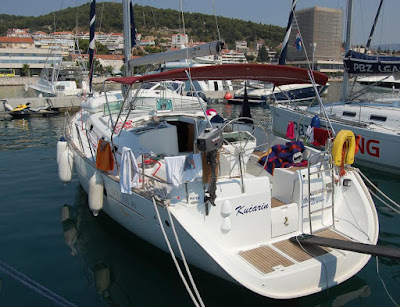
The KuĉarinThis first day we did not even cast off lines; the afternoon was spent provisioning (which entailed pushing grocery carts full of food for over 1 km), briefing, and familiarization for our boat, an Océanis 411 called the Kučarin (pronounced “Koochareen”.) In the evening, we took a water taxi to the old town, which was interesting, but I didn’t want to spend too much time there as I was still trying to catch up the sleep I had recently missed.

Day 2 – Split to Brač Island
It seems none of my crew-members are morning people, so generally we got underway around 10 or 11 every day. After tacking back and forth into the wind most of the afternoon, we decided that Brač Island was far enough, and anchored in a secluded yet crowded cove that featured two primitive, outdoor restaurants (where we would eat that evening.)

The funniest thing to happen this day occurred as we were trying to anchor. On the stern of a neighboring boat there were two completely naked, young women (we assume they were German) frolicking in the water; in fact, one of them got on a pool raft and briefly got in our way as we were laying down the anchor chain. If only I had my camera at hand (and not been busy at the windlass,) I would have photographic proof of this distraction for you now. ;-)

Mirena was happy to be back on solid ground again, so we hiked over the hill to the little, sea-side town of Milna, which was pleasant but unremarkable by Dalmatian standards as we would find out later in the week; every town, village, and burg on these islands is an idyllic, old fishing village.

Day 3 – Sail to Vis
We left our little cove on Brač and sailed most of the day on a single, south-westerly tack in moderate winds to the island of Vis. Here we found Komiža, the town, harbour, and pebbled beach where we anchored, and which would later be the cause of all our problems.
dolphins
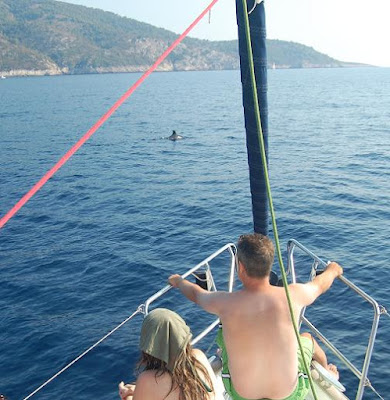
Mirena and Ken watch dolphins from the bow near Vis

Although it was almost evening, some of us swam a little bit before getting ready for dinner, as tonight turned out to be “date night” and each couple found their own restaurant in Komiža. Our group (including David, Marta, Mirena, and myself) returned to the boat first, even after traipsing all over this little town and having dinner. David and I were sitting in the cockpit watching our boat and others being blown around by the strengthening “bora” winds that were coming off the mountains in front of us and wondering if we were getting closer to the anchor buoy of the boat behind us. You have to understand that a boat will move a little in wind and waves even when anchored securely—which is, of course, disconcerting.

We did indeed lose anchorage, and David and I were forced to haul up the anchor (partly manually because the windlass circuit breaker kept tripping.) At the same time, Mike and the rest of our crew attempted to reach us with the dingy (by now we had drifted almost 1 km downwind.) Eventually we got the anchor up and motored back into the harbour where Mike had found a British guy on a similar sailing yacht who helped us out and showed us how to how to rig two anchors in series, which he said should be good for winds up to 100 knots! This being done, I felt secure and went to get some shut-eye, while the rest of the crew stayed up nervously monitoring our movement in the still increasing “bora” winds.

I guess it was an hour later when I was awoken, told to put on a life vest, and assist on deck as our anchorage had either failed or been pulled up by another nearby boat’s failed anchorage. The skies were dark, the winds were howling, and other boats whose anchorage had also failed were motoring about the harbour seemingly not knowing what to do. Mike was at the helm trying to avoid other boats and make it easier for David and Ken to manually crank the anchor chain back up (the tension on the chain prevented us from using the windlass for more than a few second before the breaker would trip—which was Melinda’s job to reset, since the breaker was in her cabin; we later joked that we would call her up unexpectedly at night and tell her “reset the breaker” just so she could relive this exciting time!) We suspected that our anchor had become entangled with another boat’s anchor (specifically the British guy who had helped us earlier,) and that indeed became apparent as we reeled in the final 10m of chain. Imagine the scene: 2 boat, each over 40 feet long, attached bow-to-bow, spinning slowly around each other as if in an lumbering dance, as we both slowly reeled in our anchors. We finally got the first anchor up, and David heroically leaned over the bow railing to untangle our friend's anchor chain—we were finally free! Disgusted with our experience in Vis, we intended to sail through the night to our next destination. This turned out to be foolhardy in these less-than-ideal conditions, so we head back and anchored closer to shore. This third anchorage was successful, and the rest of the night (what little was left) was uneventful.

Day 4 – Blue Grotto, Vela Luka
In the morning, we were able to pull into one of the coveted marina slips in Vis to refill our totally empty fresh water tanks. Had this slip been available the previous evening, we would have been well rested, and not had any of the adventures of the previous night. We had a long day of sailing planned, but decided that we had to see the famous “Blue Grotto” on Biševo Island. This is a sea cave with a fairly large chamber and two openings: one long, narrow opening that can be negotiated by a dingy, and another short one that is underwater, and gives the chamber its namesake blue hue. It took two trips for everyone to see it, but was definitely worth it.Blue Grotto
Vis
The Kučarin getting water at marina in Vis

The rest of the afternoon was spent sailing almost directly downwind in heavy seas; this was both fun/satisfying (we hit 9 knots) and—for the ladies—a little disconcerting since the boat would pitch and roll in every direction as 2 meter waves would overtake us from the stern.

We originally intended to sail to Korčula Town, but—as the light was waning—decided to pull into Vela Luka on the near side of the same island. Vela Luka was indeed a great harbour as its name suggests, but it is not the renowned fortress town of Korčula we wanted see. Never the less, we had a nice meal and managed to catch a folk dance exhibition in the town square.Croatian folk dancing
Day 5 – Lumbarda, Korčula
The next morning we immediately set sail—well, after Mike got his requisite cappuccino—for Korčula. We arrived in the early afternoon only to find that the marina was full. Continuing on to the next little town, Lumbarda, we found that their slips were also either occupied or reserved. We had promised ourselves that, at this halfway point, we would treat ourselves to a marina, where we could get a real shower, shore power to recharge phones/cameras, and not have to be ferried to/from shore by dingy every time. For this reason, Mike became very persistent—circling our boat in front of the marina’s docks until they agreed to let us “just refill our water tanks.” With this foot-in-the-door, our crew was eventually able to secure us the slip for the night.Lumbarda
Clockwise from left: Marta, Crystal, Ken, Mike, and David enjoying drinks near Lumbarda marina

Day 6 – Korčula to Mljet
Unlike previous days, we planned to stay on this island for most of the day. Most of us rented scooters to get to Korčula town and explore the rest of the island. Mirena and I set off eastward on a road that followed the coast and revealed all the little coves and idyllic sea-side towns along the way—one of which we would stop for lunch, and have one of the best meals of the trip. Despite being an under-powered scooter, Mirena insisted I was driving too fast, so I let her drive, and—by the end of the day—she had become quite competent at negotiating a scooter with two people on it over narrow, twisting roads.
Knezhe
The village of Kneže, where we ate our best lunch

The town of Korčula
The historic town of Korčula

By 19:00 we were all back on board and ready to sail on to Mljet—an island comprised mainly of national park. We had planned this to be the evening that we would eat onboard instead of going to a restaurant, and preparations were going on below deck as we sailed…err motored into the evening. As we approached the island, it was totally dark, so we had to rely solely on the GPS; unfortunately, this was located below deck, so I had to call out headings and distances to Mike at the helm—it was actually quite amazing, this would not have been possible on a pleasure craft this size before the GPS era. We expected to find a desolate anchorage, but instead circled magnificent yachts before anchoring with in sight (and earshot) of a small town inside the nation park. As we ate our dinner, we were serenaded by a saxophone player whose music carried over the water on this calm evening.

Day 7 – Mljet, Lopud, Dubrovnik marina
This final day of sailing was going to be a long one; we needed to cover the remaining distance to Dubrovnik, since we were now a day behind schedule. Still, we made a beer stop, a stop for swimming, and stopped on Lopud for dinner. As we were finishing up our Prošek, a stiff wind blew into town, and we knew that we needed to get back on the boat quickly in order to continue down the coast to Dubrovnik and hopefully outrun the approaching storm—which we did. Although it was night, and there was lightning flashing across the sky behind us, we were reassured to see the lights of Dubrovnik in the distance. Soon enough we were under the Tuđman Bridge, and aside from one final incident, found ourselves safely berthed at ACI Marina for our final night on the Kučarin.
cockpit of Kucharin
Ken, Crystal (hidden), David, Melinda (at helm), Mike, and Mirena in the cockpit of Kučarin somewhere in the Adriatic Sea

Day 8 – Dubrovnik
We had to leave the boat by 9:00 (which of course dragged out another hour plus,) and our flight back to Vienna left at 15:00. This meant we could only hit the highlights in Dubrovnik—which is an amazing city, and deserves a lot more time. Along with Marta, whose flight was also leaving around the same time, we made our best effort to see as much of the Stari Grad (old town) as possible in one afternoon. Unfortunately, after 813 photos, the battery on my camera ran out, so here is a picture taken with Mirena’s camera phone.Dubrovnik
Evaluation: This was my third sailing trip, and probably my favourite. Last year I sailed in Turkey (also with Mike) and the Caribbean with my family. What the Dalmatian Coast lacks in sandy beaches and coral reefs, it more than makes up for in its ports of call. Being the Mediterranean coast, it reminded me a lot of Turkey, but what was missing in Turkey was the living sense of history that is pervasive in Croatia. Both countries have undergone conflicts in recent history, but—although Croatia’s war was just a decade ago—it has been all patched up and its towns have a sense of timelessness more like those in Italy or Spain.

Mirena prefers snorkeling in warm Caribbean waters and missed having a sandy beach, but back on land—aside from the natural beauty (which is sometimes hard to find)—the Caribbean simply lacks the millennia of civilization that is infused throughout the entire perimeter of the Mediterranean Sea. I am convinced that a day poking around the shore anywhere in this, the hub of ancient trade would yield at least a shard of antique pottery. And, as students of western civilization, many of the stories we already know took place in this region; the island of Mljet, for example, is a more probable location of the apostle Paul’s shipwreck than the traditional site of Malta, and Homer’s Odysseus is also rumored to have visited this island.
Beach on KorchulaNotes on pronunciation: Serbo-Croatian, which despite protestations from Mirena and Marta, is indeed is the common language of Serbia, Bosnia, and Croatia—each have their own dialect that they insist is a separate language. On the Dalmatian Coast, and especially farther north in Istria, this language is spoken with a distinctly Italian cadence; without listening to the words, (many of which are recognizable to Bulgarian speakers) I could have sworn they were speaking a Romance language.

What really throws most people off though, is the elimination of the vowel “uh” in writing (both in the Latin and Cyrillic alphabets,) so if you see too many consonants in a row, throw an “uh” in there (especially before an “r”) to make it pronounceable. On this subject, you must read this humorous take that I originally thought Dave Barry wrote, but can't seem to find an attribution: Operation Vowel Drop

Pronounce most of the letter as you would expect with these exceptions: J is soft (“y”) like in German, C is always ‘ts’ as in Cincinnati, Č is ‘ch’, Š is ‘sh’, Ž is usually written ‘zh’ and pronounced like the ‘s’ in “measure”, Đ is our ‘j’; vowels—of course—are European: A=‘ah’, E=‘eh’, I=‘ee’, O=‘oh’, U=‘oo’...oh, and roll your R!

10 August 2007

Nachmittag in Wien

I finally have some time to write about my trip, so I will start with the short time (~10:30 to 07:00 the next day) in Vienna two weeks ago. But first—as Ryan likes to do—let’s talk about the Washington Dulles International Airport. Amazingly, I had a great experience this time. My arriving flight from Columbia and departing flight to Frankfurt were both in the A/B concourse, and I found the (newly discovered—for me) B concourse to be the most pleasant part of the airport to kill a few hours of a layover. The Frankfurt-bound Lufthansa flight (or was it United—I can’t remember due the pervasiveness of code-sharing) was initially delayed at the gate because of a problem with the APU (which also meant the A/C wasn’t working.) Eventually the mechanics gave up and we fired up the mains with a promise from the captain that we would make up the delay in the air. As we landed in Frankfurt the next morning, I nervously looked at the time and wondered if I could make the Vienna-bound flight to meet Mirena at the airport as planned. Then, as we were taxing to the gate, we stopped for what turned out to be 20-30 minutes because another plane was in our gate (and was not supposed to be there!) As soon as I disembarked, I began sprinting to what seemed like the other end of the airport. Having been seated for 9 hours and missing a night of sleep, this was quite a feat—overcoming a nasty leg cramp and fighting crowds in the terminal. Incredibly, I made it to the departing gate without a minute to spare!

Mirena’s flight from Sofia and my flight from Frankfurt arrived within minutes of each other, and—in fact—our flights were assigned to the same baggage claim belts, where I met her. After a joyful embrace and claiming her bag, we sadly came to the realization that my bag had not made it. Usually, I have found that baggage travels faster through a terminal than passengers, but apparently I had been able to out-run my bag in Frankfurt. Thankfully, the bag did eventually arrive later that day and was delivered to us in the city.

High Speed Sightseeing

By the time we took the train into town, it was nearly noon, so if I was going to show Mirena around town, it was going to have to be quick. We strolled down Kartner Strasse to Stephansdom, had lunch at Austria’s ubiquitous fast-food seafood restaurant, Nordsee, and coffee, Sacher torte, and ice cream in one of the numerous sidewalk cafes found inside the “ring.” Below is Mirena enjoying the liegewiese in Stadtpark, which is still as meticulously maintained as I remembered from 3 years ago.

In the evening, we went to the Prater to see the sights, ride the rides (including, of course, the Riesenrad,) and eat schweinsstelze at Schweizerhaus—which, at 2 kilos, we were sadly not able to finish.

Early the next morning we caught a SkyEurope bus to Bratislava, passing through rural Niederösterreich where it seems the fastest growing crop is wind farms. I’m really starting to wonder how much power these produce and if they are really economically feasible without special government subsidies—interestingly enough one of my shipmates, Ken, was actually an expert on the subject and we discussed this topic while sailing. So, stay tuned this and other tales from the sailing vessel Kučarin.
Mirena in StadtparkObservation: Flying over northern Virginia, it seems all you can see is suburban sprawl (from Washington DC.) Everything is either shopping centers, apartments, tract houses, or mansionettes on 1+ acre lots; all tied together by crisscrossing 4-lane highways. This is in stark contrast to the landscape that unfolds as you fly into Frankfurt. Here compact little villages are surrounded by vast stretches of forest or croplands despite the overall higher population density. I know Micah is going to rag me for this, but thinking about where I would rather live, Germany looks a lot better from the air than the typical American sprawl.

24 July 2007

The Itch

When I created The Persistent Itch (and its predecessor found at joel.froese.com/blog,) I intended it to be a travelogue—for the benefit of friends and family back home (and myself, so that I didn’t have to repeat the same thing to everyone via phone, IM, or separate emails.) Despite promising myself that I would continue to write after I returned home, there just hasn’t been much incentive to do so. I enjoy writing topical posts, but they do require more effort, and—since my primary audience is no longer reading this blog—I see no reason to do so.

The remaining three topics I promised you on March 14th, as well as a further theory on economic development and a scathing review of Michael Moore’s Sicko that I’ve been meaning to write, have been put on the back burner indefinitely.

I say all this to say that I am returning The Persistent Itch back to its roots; on Thursday I fly to Vienna to meet my girlfriend, and then we will fly on to Split, Croatia where we will meet friends for a week of sailing the Dalmatian Coast down to Dubrovnik. Expect glowing reports and stunning photographs starting next week.

In family news, the Froese family grew by two within the last three weeks as Jordan (left) was born to Micah and Debora on July 6th and Hutch (right) was born to Simon and Sarah on the 19th. All of the babies, parents, grandparents, and uncle are happy and healthy!

Jordan Lee with Uncle JoelHutch Brockton with Uncle Joel

28 April 2007

The real digital divide

The “digital divide” is supposedly a socio-economic division that is propelling young, rich and middle class kids into a wonderful, new, technology-based economy, while leaving behind lower classes—especially those growing up in the developing world. Earnest crusaders are bridging this gap by setting up computer labs in schools and community centers for disadvantaged youths, and even building $100 laptops for kids in the developing world. This is admirable, and I appreciate anyone giving their time and money to help disadvantaged kids, however I wonder: what is this really helping? Now these kids can create their own Facebook page and copy and paste from Wikipedia for their school projects like their more affluent peers—is this really a step in the right direction? By virtue of the fact you are sitting here reading my ramblings (and I have spent time writing them for this forum) we know that the Internet is more often just a time waster. The cynic in me (and I am probably not alone) looks at the picture below, and braces for an onslaught of even more 419-style email spam.

No, the real digital divide is a generational divide; its victims are often otherwise successful and affluent professionals, business leaders, “old-economy” corporations, and even entire sectors that just don’t get it. The most obvious example is the music and film industries; as entertainment is increasingly being distributed and delivered digitally, traditional distributors and retailers of these goods are becoming increasingly irrelevant. Instead of finding sensible ways of delivering this content to consumers (meaning cheaper and more convenient,) they have balked—either by ignoring the reality of how music is being “consumed,” or by proposing ridiculous schemes whereby consumers are locked into a particular technology, yet given no significant discount for buying this crippled product. Let’s face it, it is technologically impossible to create a format that can be played on a variety of players from different manufactures and—at the same time—be hacker-proof.

Therefore, I predict that the traditional distribution channels for music will shrivel up and eventually die, as the industry continues to push for more onerous restrictions (namely Digital Rights Management [DRM] schemes, constraints on the types and number of playback devices an individual can use, and limitations on sharing music among friends,) all of which will drive consumers to “pirating.” What will eventually replace the current “music labels,” will be an E-bay like marketplace where consumers buy music directly from the musicians—cutting out the middle man—at a fraction of the current retail price. Musicians will gladly allow consumers to freely share their music with friends, as this will grow their audience.

Likewise, the sale of movies will have to radically change as the general population will have access to ever increasing bandwidth, meaning high-resolution movies will be able to be delivered via the Internet. Certainly movie theaters/cinemas will continue thrive as they have through the advent of TV, VCR, and DVD. But if the movie studios think they can retail movies for the same prices as they do DVDs—which is what they are trying to do now—then they are kidding themselves. A downloaded movie has to priced at least half of what a DVD costs since you are providing your own storage, and no longer have access to a real, physical backup copy of the movie. [2016 Update: It looks like I didn't see the streaming revolution coming.]

I’ve actually gone out on a tangent with this rant on the entertainment industry. What I really wanted to say is that I have had the experience of helping people with their websites both at home and abroad, and I’ve noticed that otherwise successful business people of a certain age want their websites to look like a slick brochure. The result is a lot of websites with text in graphics, 100% Adobe Flash sites, and other obvious self-sabotage. On the Internet, content almost always trumps presentation: just look at the minimalist design of ultra-successful sites like Google and Craig's List.

Furthermore, what is more important nowadays is to be part of the Internet community rather than an “island” website unconnected to the rest of the net. In fact, it turns out that many individuals and small organizations simply don’t need their own website. An individual or artist/band will find that a MySpace profile is more useful and easier to create and maintain. Likewise, a professional will find LinkedIn to be more useful for networking, and even small net-based retailers would find Cafe Press, Yahoo! Store, or even Ebay to be a more efficient way to list and sell their merchandise. Hmm, Joel.Froese.com is up for renewal in May; I wonder if I really want to renew it now. [2016 Update: Indeed, I couldn't justify the $35/year price, and have let my original website expire.]

04 April 2007

Petroleum: your all-natural, organic choice in energy

With trouble in the Middle East and gas prices approaching $3 per gallon, everyone is concerned about fuel prices. However, it seems most Americans have not changed their driving habits or dumped their gas-guzzling SUVs. Instead we are looking for salvation in biofuels (ethanol and bio-diesel) and hydrogen/fuel cell technology. What is conveniently forgotten is the cost of these technologies—both economic and environmental. The process of making biofuels generally consumes more than half of the energy that it produces, and is only feasible because of government subsidies. Worst of all, using agricultural resources for fuel instead of food means our grocery bills will increase—most adversely affecting the poor. Agricultural land, although plentiful, is a finite resource, as are the nutrients in that soil—which ironically, are usually supplemented by petroleum-based fertilizers. One insightful farmer noted “The ethanol craze means that we're going to burn up the Midwest's last six inches of topsoil in our gas-tanks.”

To me, it seems strange that ethanol and bio-diesel are considered a renewable, “green” energy source. I’m not an environmentalist; I just like pointing out the intellectual dishonesty of championing biofuels as a preferable alternative to petroleum. In terms carbon output, the only difference for biofuels is that the cultivation of inputs (corn, sugar, or switchgrass) supposedly offsets the burning of the resulting fuel later; however, in most cases, the land used to cultivate these crops would have some kind of carbon-sequestering plant life on it in any case. Furthermore, ground-level pollution from biofuel use and manufacture shows few advantages over petroleum. The fact of the matter is that biofuels are manufactured in a factory, whereas petroleum is naturally produced by the earth over millions of years from basically the same inputs. Granted, crude oil must be refined before it can be used (as gasoline, diesel, and other petrochemicals) but this processing is minimal compared to the manufacture of biofuels; in other words, switching from petroleum to biofuels requires expanding the capacity and/or number of already unpopular fuel plants (be they refineries or ethanol plants.)

The other alternatives for mobile/portable fuel are batteries, fuel cells, and hydrogen. These zero-emission energy sources sound great until you look at the source of the energy required to charge the system or extract hydrogen from water or other compounds (often petroleum.) Certainly real, renewable energy sources like wind, water, and solar power would be great, but realistically these sources contribute only a small percentage to the total electricity used in the US, and—for practical reasons—this will remain so for a long time; electrical power will likely continue to be produced mainly from the dirtiest source of energy: coal.

Therefore, I propose that the most sensible course of action is to continue to use this perfectly natural source of energy for as long as we still have it. By virtue of the fact that oil is becoming scarcer, the market will automatically reward makers of more efficient vehicles, engines, and other processes that use petroleum. Eventually, even more expensive alternatives energy sources will become economically feasible to develop—and without artificial incentives!

Of course I am all for conservation of all our natural resources; I am particularly irritated by the thoughtless waste that is characteristic of American society. Particularly when it comes to petroleum, this waste is directly responsible for making us dependent on some of the most reprehensible governments in the world, simply because they have the majority of the world's crude oil reserves. I say let’s tap the ANWR and other verboten reserves within our territory; there is no reason to let this perfectly good resource go to waste. Our current policy regarding these reserves are as if you were to go down to your wine cellar, (assuming you have such a thing) notice that racks are starting to look a little empty, and then swear off your finest, well-aged wines forever in favor of cheap domestic beer.

01 April 2007

Cooper River Bridge Run

On Saturday, the 30th Annual Cooper River Bridge Run—a 10 km foot race—took place in Charleston, South Carolina. I had heard about this event for many years, but never considered it because I am not a runner. This year, my father decided to participate. He instructed his daughter-in-law to register him for the event, but then registered himself on the website as well. This meant that there were two runner’s packets available, and I felt had no choice but to participate despite having not trained at all—outside a few Hash House Harrier runs every other week.

We left Columbia at 5:00am in order to arrive in Charleston with plenty of time to get prepared—which was a good thing, because getting the runner’s packets from the friend who picked them up turned out to be quite challenging. Despite this hitch, we were ready an hour before the start time, and made our way to the start line in Mount Pleasant to join over 40,000 other runners and walkers who were lining up for the event. Understandably, I was anxious knowing that, despite having the option of walking the course, I would get caught up in the spirit and competition of the event and run 6.2 miles with absolutely no training—and suffer the consequences afterwards (which I am, as I write this on Sunday.)

The magnitude of this event is difficult to fully convey; with 40,000+ competitors, there seems to be an endless line of people ahead and behind you. When the official start time came, and the clock began ticking away, I was not able to get over the start line for another three and a half minutes. Throughout most of the event, competitors spanned all 4 lanes of the road—we were racing 20+ wide!

I felt amazingly good for the first 3 miles; I ran 10-minute miles up to this halfway point (which also coincided with the peak of the namesake Cooper River Bridge.) However, on coming down the bridge into Charleston, my knees started hurting, and I was forced to walk. Despite the pain, I couldn’t stand watching hundreds of people go by me, so I would alternately run and walk for the rest of the race.

Some people take this 10K less serious than others; I saw all kinds of whimsical costumes. The following all participated in this event: some girls in hoop skirts, a group of people in banana costumes and in bowling pin costumes. I saw two brides, one of which actually was wearing a short wedding gown and carrying a bouquet; her husband (or fiancé) was running beside her in a tuxedo t-shirt. At least two marines in BDUs, combat boots, and carrying 55 lbs of weight in a backpack. However, my favorite was a group of guys dressed as bulls followed by a group of girls in white (al la “running of the bulls” in Pamplona, Spain—except they should have been in front of the bulls.)

I crossed the finish line at 1:08:38, making me the 12,540th finisher (out of 28,641.) My father (middle) was 13.5 minutes faster, and placed 14th in his age group. My niece (right) was 25 seconds faster than him with an official time of 54:38.
Joel, Arno, and Dana Lee
We had lunch in the beautiful, historic district of Charleston, and then spent the afternoon on Folly Beach. The water was a bit too cold, but the weather felt almost summer-like. All in all, it turned out to be a wonderful day; even the pain is a “good hurt”; I know this makes me stronger!